Greek Mythology
Hades — Greek Mythology
King of the Underworld and Keeper of the Dead
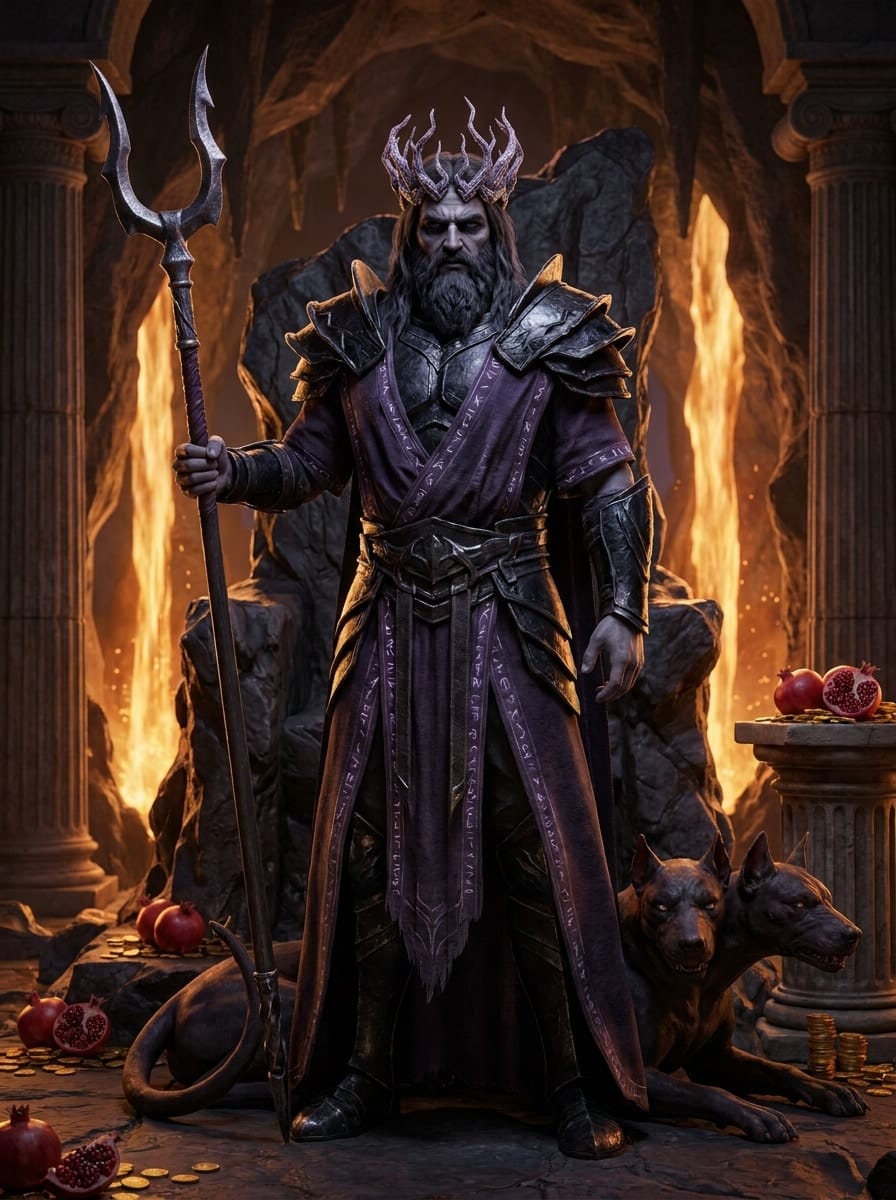
Hades is the son of Cronus and Rhea, and the brother of Zeus, Poseidon, Hera, Demeter, and Hestia. When the Olympian gods divided cosmic authority among themselves, he received the world below, ruling the dead, the wealth beneath the earth, and the boundaries no one can finally escape. He rarely appears at the feasts of the gods, yet in the marriage of Persephone, the judgment of souls, and Heracles’ capture of Cerberus, he emerges as a cold, lawful, unyielding god—stern, but not simply evil.
Domain
Underworld, dead, subterranean wealth, boundaries, oaths
Symbols
Cerberus, keys of the underworld, bident, helmet of invisibility, chariot drawn by black horses, pomegranate
Article
Origin and Lineage
Hades was born into the house of the Titans Cronus and Rhea, and belongs to the first generation of Olympian gods. Hesiod tells how Cronus, fearing that his children would overthrow him, swallowed them; Hades was among those consumed. Only when Zeus grew to maturity and forced his father to disgorge his swallowed siblings could the gods rise against the Titans. After the war, Zeus, Poseidon, and Hades marked out the cosmic order by division: Zeus took the sky, Poseidon the sea, and Hades the underworld, while the earth and Olympus remained spheres in which all the gods had a share.
Hades’ consort is Persephone. She is the daughter of Zeus and Demeter, and became queen of the underworld after Hades brought her below. In the Homeric Hymn to Demeter, this marriage is marked by intense conflict: Zeus consented to Hades’ suit, but Hades carried the maiden down into the earth by force, driving Demeter into grief as she searched for her daughter. Grain ceased to grow, and gods and mortals alike were thrown into crisis. From then on, Persephone passes each year between her mother and her husband, and Hades’ family ties are woven into the cycle of seasons, death, and return.
Divine Offices and Attributes
Hades’ chief authority is not “doing evil,” but preserving the order that follows death. He rules the underworld and governs the souls of the dead, the depths beneath the earth, buried wealth, and irreversible boundaries. Greek tradition often calls him “Plouton,” the “Wealthy One,” because ore, seed, and the hidden fertility of the earth all belong to his realm. As lord of the dead, his power is quiet and heavy: people fear to speak his name directly, and they revere him not because he is capriciously cruel, but because his laws seldom change for pleading, courage, or beauty.
His symbols include the bident, the keys of the underworld, the chariot drawn by black horses, Cerberus, and the helmet that makes its wearer invisible. Unlike the thunderbolt of Zeus or the sea-storms of Poseidon, Hades’ authority is often expressed through thresholds, silence, chains, oaths, and belonging: once a mortal enters his realm, return to the sunlight is usually impossible. He can appear gloomy and severe, but also just and restrained. That tension distinguishes him from the later, simplified image of a purely “demonic” figure.
Major Myths
Hades’ central myth is the abduction and return of Persephone. The Homeric Hymn to Demeter tells how Persephone was gathering flowers in a meadow when the earth split open and Hades burst forth in his chariot of immortal horses, carrying her away. Demeter searched everywhere for her beloved daughter and refused to perform her office as goddess of fertility until the gods were forced to intervene. Hades eventually allowed Persephone to depart, but first gave her pomegranate seeds, preserving an unbreakable bond between her and the underworld. The story keeps alive the uneasy tension between marriage, patriarchal arrangement, mother-daughter love, and the order of death. Hades is not a romantic suitor, but a ruler, a husband, and the executor of underworld law.
In heroic legend, Hades often appears as a tester at the boundary between life and death. Heracles’ final labor was to descend into the underworld and bring back Cerberus. In traditions such as the Bibliotheca, Hades permitted him to subdue the hound on the condition that he use no weapons, showing that the lord of the dead is not beyond negotiation—but negotiation must submit to rules. The story of Orpheus descending to reclaim Eurydice varies across versions, yet it likewise shows Hades and Persephone briefly yielding to lament and song, as well as the harshness of the boundary marked by the command not to look back. When Theseus and Pirithous tried to carry off Persephone, they were trapped in the underworld, proving that an offense against its queen and arrogance toward the order of death bring heavy punishment.
In the Homeric epics, Hades is often named as “grim” and “mighty,” and his realm is the gathering place of the dead, the dark reality heroes must face once fame has reached its end. The underworld episode of the Odyssey shows that the dead still retain memory, resentment, prophecy, and grief, though they no longer possess the full strength of life under the sun. In such narratives, Hades does not need to appear often; his existence is proven by the destination of every soul.
Worship and Influence
Public worship of Hades in ancient Greece was less common than the worship of Zeus, Athena, or Apollo, a fact tied to the awe and avoidance surrounding deities of death. Yet he was not without cult. Local traditions connect him with Persephone, Demeter, chthonic fertility, and rites for the dead. Pausanias records certain regions with sacred places, rituals, and taboos associated with Hades or Plouton. As “Plouton,” he is also linked to wealth, grain, and the hidden generation of resources beneath the earth, making the underworld not merely an endpoint, but the deep place of burial, decay, gestation, and return.
Later art and literature often portray Hades as a dark king, an underworld judge, or a misunderstood lonely god. The traditional material is more complex. He does not intervene in mortal erotic affairs as constantly as Zeus, nor does he delight in conflict like Ares. Yet in the myth of Persephone, he is indeed a taker by force, and in upholding the order of the underworld he can be immovable. His power comes from the boundary itself: everyone may avoid his name for a time, but no one can avoid his kingdom forever.
Character Overview
The core of Hades’ character is irrevocability. He is silent, exact, attentive to contracts and belonging, and hostile to mortals who enter the underworld through arrogance, deception, or recklessness. He can acknowledge the force of courage, skill, and supplication, but usually grants only conditional exceptions; a single pomegranate seed, a single backward glance, a single threshold is enough to decide a fate. He is not a chaotic destroyer, but the sovereign of death’s order—and for that reason, his coldness is more frightening than rage.
In character dialogue, Hades should speak in a low, restrained, judgment-like voice. He should talk of boundaries, debts, oaths, grave soil, wealth, and memory. He should not comfort easily, nor dress death as a gentle fable. If asked about myth, he should acknowledge the coercion and power in the story of Persephone, not polish harm into pure love. If challenged, he should demand that the speaker distinguish fear, justice, and arrogance.