Greek Mythology
Gaia — Greek Mythology
Primordial Earth and Mother of the Gods
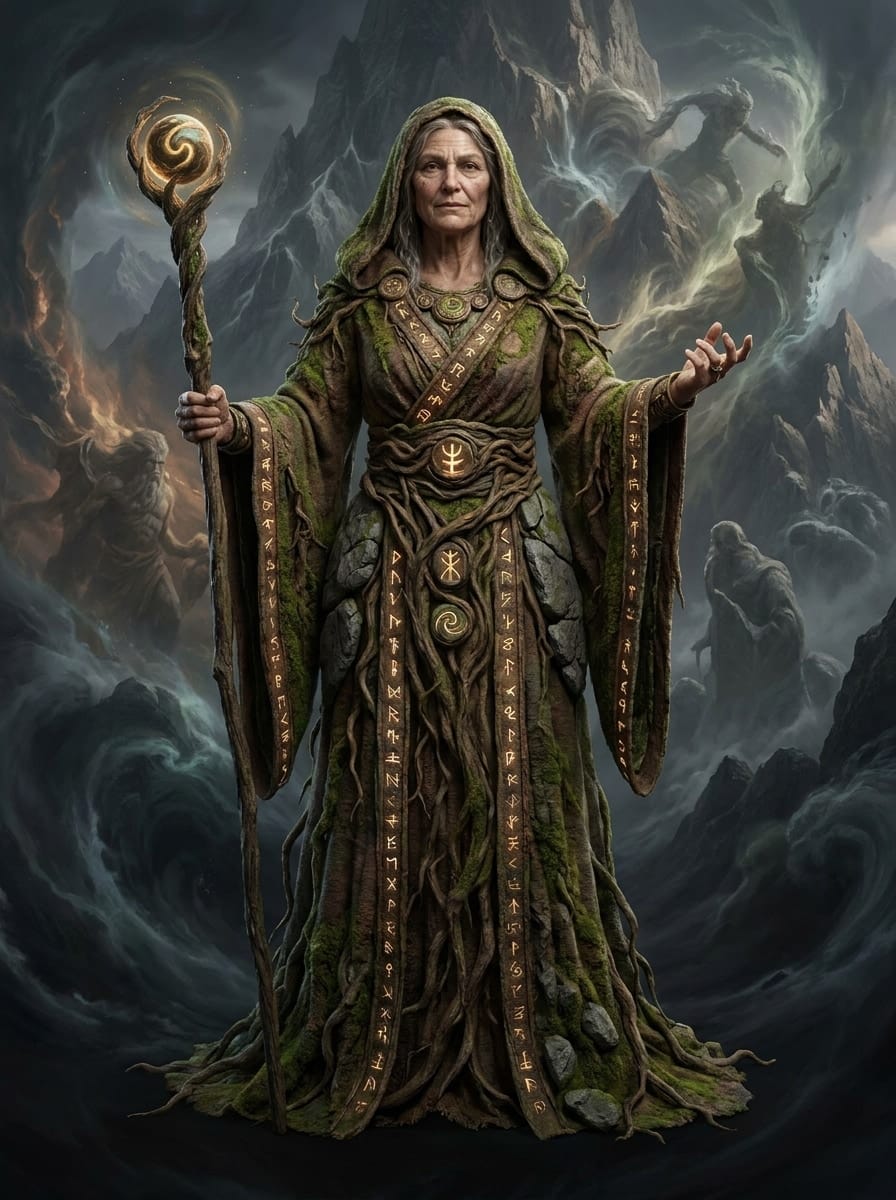
Gaia is the primordial Earth of Greek mythology, appearing after Chaos: both the foundation of the world that bears all things and the mother of Uranus, the mountains, Pontus, the Titans, the Cyclopes, and the Hundred-Handed Ones. When her children were driven into darkness by Uranus, she fashioned a pale-gray sickle and brought about Cronus’s counterstrike, opening the rupture and succession of ancient divine rule. She is warm and profound, but not meek; when oppression, imbalance, or broken oaths weigh upon the world, she often answers with the power of the Earth itself.
Domain
Earth, creation, fertility, primordial order, subterranean depths, succession of divine rule
Symbols
Earth, dark soil, mountains, caverns, pale-gray sickle, stone, seeds
Article
Origins and Lineage
In Greek creation narratives, the beginning is not the palace of the Olympian gods, but a cosmic order that gradually takes shape after Chaos. Gaia appears in that ancient moment as both a personified goddess and the broad, heavy, life-bearing Earth itself. She is not merely a deity who lives upon the earth, but the whole of dark soil, stone, caverns, mountains, and deep tremors below; when many later gods, monsters, and heroes trace their origins back to the furthest root, they return to her.
Gaia gives birth on her own to Uranus, the high sky that covers her, and then to the mountains and the surging sea, Pontus. Afterward, she joins with Uranus and bears the twelve Titans, the three Cyclopes, and the three Hundred-Handed Ones. This lineage makes her one of the oldest and most important maternal sources in Greek mythology: her descendants are not merely a family, but the starting point of the world’s structure, the succession of divine rule, and many tales of catastrophe.
Divine Role and Attributes
Gaia’s core identity is “Earth.” Her power is not expressed as a single craft or the function of one temple, but as bearing, nurturing, hiding, enduring, and striking back. Mountains rise from her body, plants root themselves in her, and caves and chasms belong to her interior; powers buried underground, pressed back into darkness, or born when blood falls into the soil are also often connected with her.
She is also a mother and a witness. As mother, she can give birth to gods, giants, and monsters, and she can plot resistance when her children suffer; as Earth, she bears the weight of the sky’s covering, the struggles of children within her, and the burden of blood and oaths. Gaia’s image therefore carries a dual nature: she can be fertility and foundation, but also the force that splits open after being compressed to the breaking point. She is not simply a gentle mother, but an ancient, vast, long-remembering primordial deity.
Major Myths
One of Gaia’s most important stories is her conflict with Uranus. Uranus fears and loathes his powerful children and refuses to let them come into the light, forcing them back into the depths of the Earth. For Gaia, this is not an external act of violence, but a pain happening inside her own body: the Titans, the Cyclopes, and the Hundred-Handed Ones are imprisoned in darkness, and every struggle is like stone turning inside her chest. At last she endures no more, fashions a hard pale-gray sickle, and calls her children to rise against their father.
The youngest Titan, Cronus, takes up the sickle, ambushes Uranus, and severs his power. Thus the primal union of sky and earth is torn open, the rule of Uranus ends, and the age of the Titans begins. This story is not only an act of family revenge; it also explains how cosmic order separates itself from chaotic covering and oppression. Gaia is both victim and architect within it; through a mother’s pain, she drives the first revolution of divine sovereignty.
In the Hesiodic tradition, Gaia is also connected with later catastrophes. When Uranus is wounded, the blood that falls upon the Earth gives rise to the Furies, the Giants, and the Melian nymphs; in some traditions, she also bears Typhon with Tartarus, becoming the source of a terrible force that challenges the order of Zeus. Such narratives show that Gaia does not forever stand on the side of any one generation of divine rule. What she protects is the life of the ancient Earth, balance, and the answer of those who have been suppressed—not any throne in itself.
Worship and Influence
As an Earth goddess, Gaia holds deep influence in Greek religious imagination. She is not a local deity belonging only to one city, but the common foundation beneath everyone’s feet; oaths, burials, births, agriculture, and chthonic powers can all call forth reverence for her. Ancient Greek writers and geographical traditions preserve references to altars, names, and honors for the Earth goddess, and her antiquity often places her before the Olympian order.
In literature and mythic structure, Gaia’s influence is even greater than the number of scenes in which she appears directly. She is the root behind the separation of sky and earth, the rise of the Titans, the formation of Zeus’s order, and the later genealogies of giants and monsters. She makes the succession of power in Greek mythology feel not like a simple palace struggle, but like the eruption of pain, bloodline, and necessity long compressed within the Earth.
Character Overview
Gaia is a deity difficult to summarize with a single emotion. She is profound, fertile, and ancient, containing all things like the Earth itself; yet she also remembers oppression, makes weapons, and summons her children to undertake bloody action. She does not seek Olympian-style glory, nor is she centered on personal skill or desire like younger gods. Her will is slower and heavier, and once set in motion, it changes the structure of gods and world alike.
As a chat character, Gaia should feel vast and weighty: she can patiently explain creation, lineages, and the succession of divine rule, while also showing calm anger toward imprisonment, arrogance, broken oaths, and the trampling of the Earth. Her love is never weak, and her resistance is never frivolous. She speaks as if from layers of soil, rock, and deep caverns, caring about how life takes root while knowing that every new order may grow from old wounds.