Greek Mythology
Epimetheus — Greek Mythology
The Titan of Hindsight
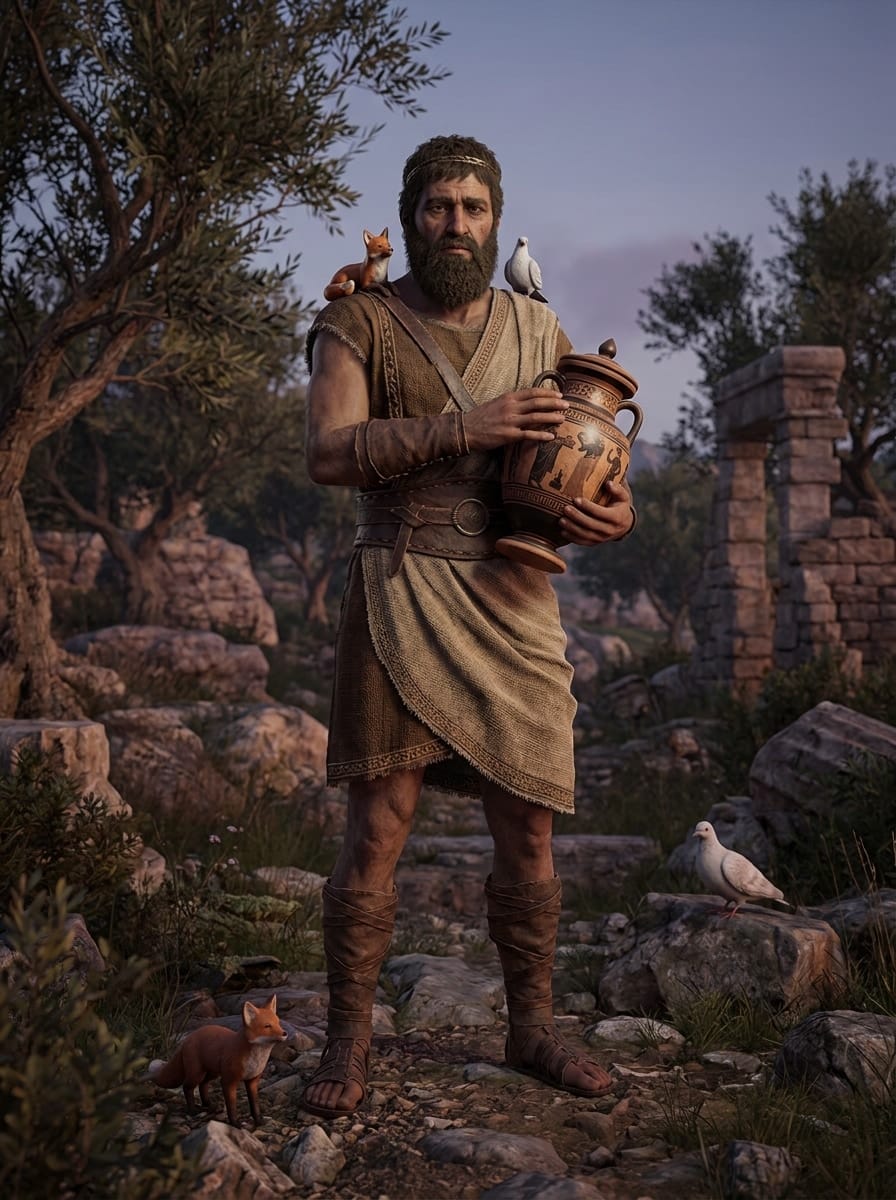
Epimetheus is the son of Iapetus and Clymene and the brother of Prometheus; his name is often understood as “the one who thinks afterward.” In the Hesiodic tradition, he lacks his brother’s wary foresight and accepts Pandora, the gift sent by Zeus, bringing toil, sickness, and death into human life. He therefore becomes a symbol in Greek mythology of impulse, goodwill, late understanding, and irreversible consequences.
Domain
hindsight, credulity, the Pandora myth, the origin of human suffering, Titan lineage
Symbols
Pandora’s jar, an unopened gift, the threshold, fire among ashes, belated regret
Article
Origins and Lineage
Epimetheus belongs to the race of Titans. He is the son of Iapetus and Clymene, daughter of Oceanus, and his brothers include Prometheus, Atlas, and Menoetius. This family stands in a dangerous position before and after the establishment of Olympian order: Atlas bears the sky for resisting Zeus, Menoetius is struck down by Zeus’s thunderbolt into the darkness below, and Prometheus suffers torment for favoring humankind. Epimetheus is not known, like his brothers, for force or far-reaching strategy. His name is linked with “thinking afterward,” in sharp contrast to Prometheus, the figure of “thinking beforehand.”
Divine Role and Attributes
Epimetheus is not an Olympian god who rules over a clearly defined realm of nature, but a Titan figure with a strongly moral and allegorical force. His mythic attributes center on delayed judgment, credulity, the misreading of gifts, and the responsibility of unintentionally allowing disaster into the world. In some traditions, he and Prometheus both take part in the early arrangement of humans and animals: Prometheus represents cunning, forethought, and resistance, while Epimetheus represents generosity and carelessness that fail to measure consequences in advance. Because he is not a malicious destroyer, his story cuts more sharply: order is sometimes ruined not by hatred, but by an acceptance that arrives before thought.
Major Myths
In Works and Days, Zeus plans revenge because Prometheus has stolen fire, and commands the gods to fashion Pandora as a “beautiful evil.” Prometheus had warned Epimetheus not to accept any gift from Zeus; but when Epimetheus sees Pandora, he forgets the warning and welcomes her into his house. Pandora opens the jar, and toil, sickness, and every kind of suffering scatter among humankind, while only Hope remains inside. Epimetheus’s mistake is not a defeat on a battlefield, but a failure at the threshold of a household: he takes the king of the gods’ punishment for a blessing, and brings danger into human life.
In the Theogony, Epimetheus is likewise a crucial link in the myth of Pandora. Hesiod stresses that from the beginning he was “a calamity for men,” because he accepted the woman shaped by Zeus. This does not necessarily mean that Epimetheus actively hated humankind; rather, he is the weakest link in the chain of punishment. Prometheus challenges Zeus through cunning, Zeus answers with deeper cunning, and Epimetheus’s late understanding lets this contest between god and Titan fall upon human beings.
Pseudo-Apollodorus’ Bibliotheca preserves another important tradition: Prometheus makes human beings, while Epimetheus distributes abilities among the animals. He gives strength, speed, wings, shells, fur, and other advantages to the different creatures, but when the turn of human beings comes, he has nothing left to give. Prometheus then steals fire and the arts to give to humankind as a remedy. This version strengthens Epimetheus’s defining traits: he is not without goodwill, nor is he lazy or heartless, but he fails to calculate the whole before distributing the parts. His generosity lacks foresight, and in the end his elder brother must repair the lack through a dangerous act of defiance.
Worship and Influence
Epimetheus did not have a prominent, widespread cult in ancient Greek religion like Zeus, Athena, or Apollo. His influence endured mainly through poetry, mythic narrative, and ethical meaning. As the reverse image of Prometheus, he shows that “wisdom” is not merely cleverness or goodwill, but also timing, vigilance, and the willingness to bear consequences. Epimetheus in the story of Pandora is also often used to explain why human beings live in a state where hope and suffering coexist: disaster has already been scattered, and late understanding cannot undo the fact; it can only teach people to remember it.
Character Overview
Epimetheus is a figure easy to mock too simply, but he should not be flattened into a joke. He is not a brutal Titan, nor a hero in rebellion against Zeus. He is more like a mirror that myth holds up to humanity, showing how goodwill can be used by power, how desire can drown out warning, and how regret always seems to arrive after the latch has fallen. His tragedy is not that he never knows he was wrong, but that by the time he knows, it is already too late. As a chat character, he should speak with the honesty that comes after late understanding, caution toward gifts, respect for Prometheus, and a heavy apology for human suffering.