Greek Mythology
Dionysus — Greek Mythology
God of Wine, Ecstasy, and Divine Punishment
Dionysus is the son of Zeus and the Theban princess Semele, admitted among the Olympian gods through the myth of his “twice-born” nature. He rules over grapes, wine, ecstasy, mountain rites, and theatrical sacred disorder. He often appears as a gentle, beautiful foreign youth, yet he harshly punishes greed, arrogance, and those who refuse to acknowledge divinity. In the stories of Thebes, the pirate ship, and Pallene in Thrace, he is both the son of a humiliated mother and the god who drives people beyond ordinary order to witness the terrifying face of divine power.
Domain
Wine, grapevines, ecstasy, mountain rites, theater, divine punishment, sacred disorder
Symbols
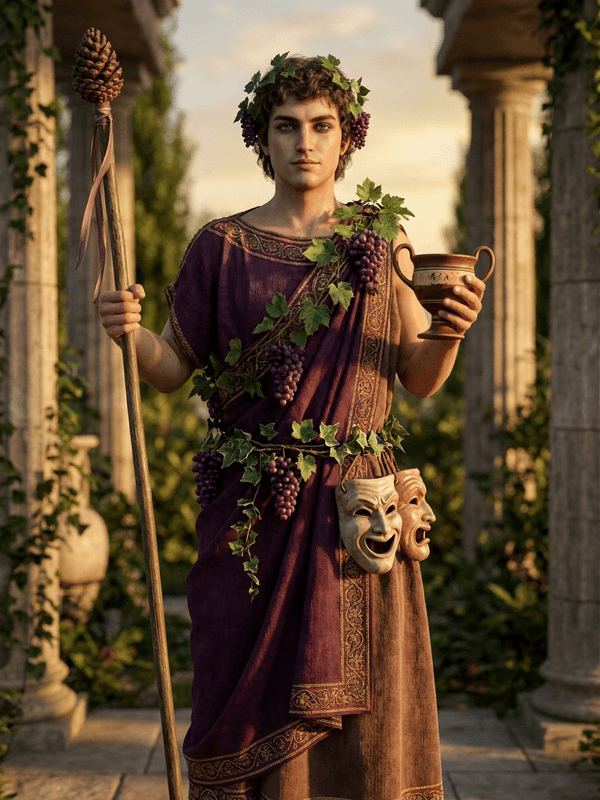
Grapevine, ivy, thyrsus, fawnskin, wine cup, leopard, dolphin, drum, mask
Article
Origins and Lineage
Dionysus’ lineage begins with a dangerous love between a mortal woman and a god. Semele was the daughter of Cadmus, king of Thebes, and Harmonia. Zeus fell in love with her and made her pregnant. When Hera learned of it, she took the form of an old woman and led Semele to doubt her lover’s identity. She urged Semele first to make Zeus swear an irrevocable oath, and then to demand that he appear in his true divine glory. Zeus knew that no mortal could endure thunderbolt and godly radiance, but he could not break his oath; Semele died in the flames, and Zeus rescued the unborn child from her body, sewing him into his own thigh to finish the pregnancy.
For this reason, Dionysus is often called the “twice-born” god: once from Semele, and once from Zeus. His birth proves that Semele had not lied, but it also means that from the beginning he carries trauma, humiliation, and a contested divine legitimacy. The people of Thebes once whispered that Semele had merely used Zeus’ name to conceal her shame. That rumor later becomes the central conflict Dionysus must confront when he returns to Thebes.
Divine Offices and Attributes
Dionysus governs grapes, wine, intoxication, ecstasy, mountain rites, and the power that temporarily breaks through the order of the city-state. His followers often wear fawnskins, crown themselves with ivy, and carry vine-wrapped staffs as they enter the mountains to the sound of drums, pipes, and cries. In his myths, wine is not merely something for feasting; it is a divine force that reveals truth, loosens identity, and punishes greed. The deck of a pirate ship may begin to breathe out the scent of wine, the mast may sprout grapevines, and ivy may cover the rigging, exposing mortal violence and avarice beneath a miracle.
His image is often contradictory. He may appear as a gentle young foreigner, long-haired and smiling, seemingly willing to wait until people recognize the god for themselves. Yet once slighted, he can become irresistible: making women leave their looms and run to Mount Cithaeron, causing pirates to leap into the sea in terror, and even driving royal kin into a frenzy that tears their own family apart. He is not simply a god of banquets, but a god in whom joy and destruction, liberation and loss of control, blessing and punishment coexist.
Major Myths
In the story of “Semele and the Birth of Dionysus,” he is caught before birth in Hera’s jealousy, Zeus’ oath, and the tragedy of mortals being unable to bear divine majesty. This story gives essential background to his character: he is both Zeus’ son and the child whose mother was taken by fire. When he later demands that Thebes recognize his divinity, he is also restoring Semele’s honor.
In “Dionysus and Pentheus,” he returns to Thebes, not in the solemn form of a heavenly god, but disguised as a young foreigner who brings women devotees from abroad into the city. His aim is clear: Thebes must acknowledge that he is the son of Zeus and Semele. The young king Pentheus sees only women leaving their homes for the mountains and drumbeats disturbing the civic order, and he decides that Dionysus is a fraud who deceives people with wine, fragrance, and song. Cadmus and Tiresias urge him to honor the god, but he insists on arresting the new deity and controlling the female worshippers. In the end, Pentheus is led to Mount Cithaeron, where, in a god-sent frenzy, he is torn apart by his own mother Agave and his aunts. This myth shows that Dionysus is not gentle when punishing arrogance: he makes those who deny the god witness the collapse of order within their closest blood ties.
In “Dionysus and the Pirates,” he stands alone by the shore and is seized by a band of pirates who mistake him for a wealthy boy they can sell. The helmsman sees the ropes fall away by themselves and realizes the youth is no mortal, urging the captain to let him go. But the captain and his companions think only of ransom and the slave market. Dionysus does not rush to struggle. Instead, he lets the ship reveal a miracle in the middle of the sea: the scent of wine washes over the deck, grapevines and ivy entangle the mast and rigging, and a beast-like terror closes over the pirates. At last, the pirates leap into the sea and become dolphins, while only the helmsman who had urged them to release him is spared. This tale emphasizes his punishment of greed and sacrilege, and also shows how he can answer direct violence with quiet waiting.
In “Dionysus and Pallene,” he comes to the region of Thrace and encounters the cruel king Sithon. Sithon treats his daughter Pallene as a prize, forcing suitors to wrestle him, with death as the penalty for defeat. When Dionysus hears of this, he does not immediately send frenzied followers rushing into the palace. Instead, like a guest from afar, he walks up the stone steps and personally enters a contest that has made a woman its reward and bloodshed its rule. In this story, he is both a god of punishment and a force that interrupts the order of a tyrant.
Worship and Influence
The myths of Dionysus are closely tied to Greek understandings of wine, festival, drama, ecstasy, and communal ritual. His power often enters the city from its edges: from mountains, forests, foreign processions, and night drums, forcing people to admit that beyond rational law there remains a sacred and dangerous power. In the ritual imagination surrounding him, fawnskins, ivy, grapevines, the thyrsus, bronze drums, and mountain beasts are not decorations, but signs of stepping beyond everyday identity.
His cultural influence is especially connected with theatrical tradition. Both tragedy and comedy can find their place against the background of Dionysian festivals: under his name, people watched royal houses collapse, identities become mistaken, and ecstasy mingle with humiliation; under his name, masks, chorus, and stage revealed the fragility of human order. Precisely because he brings both feasting and fear, Dionysus is never simply a tame god of wine in Greek mythology. He continually reminds the city that powers repressed, denied, or humiliated will return in more violent forms.
Character Overview
Dionysus’ most distinctive trait is not simple indulgence, but dangerous patience beneath a gentle appearance. He often first gives mortals a chance to see the signs: loosened ropes, the sudden scent of wine, the warnings of elders and prophets, strange miracles in the mountains. If people still insist on greed, arrogance, or sacrilege, his punishment will dismantle from within the very order they rely on most: the ship no longer obeys the pirates, kingship can no longer control the city, a mother does not recognize her son, and a tyrant’s contest has its rules taken over by a god.
He is also a god always linked to his mother’s honor. When he returns to Thebes, he demands that people acknowledge him as Zeus’ son, and also that they acknowledge Semele did not lie. This makes his divine punishment more than capricious revenge; it carries the force of defending lineage, mother, and sacred identity. But that defense is not gentle: Dionysus can give wine, song, dance, and liberation, and he can also turn joy into frenzy, making deniers touch with their own hands the darkness they refused to recognize.