Greek Mythology
Demeter — Greek Mythology
Goddess of Grain, Abundance, and Maternal Grief
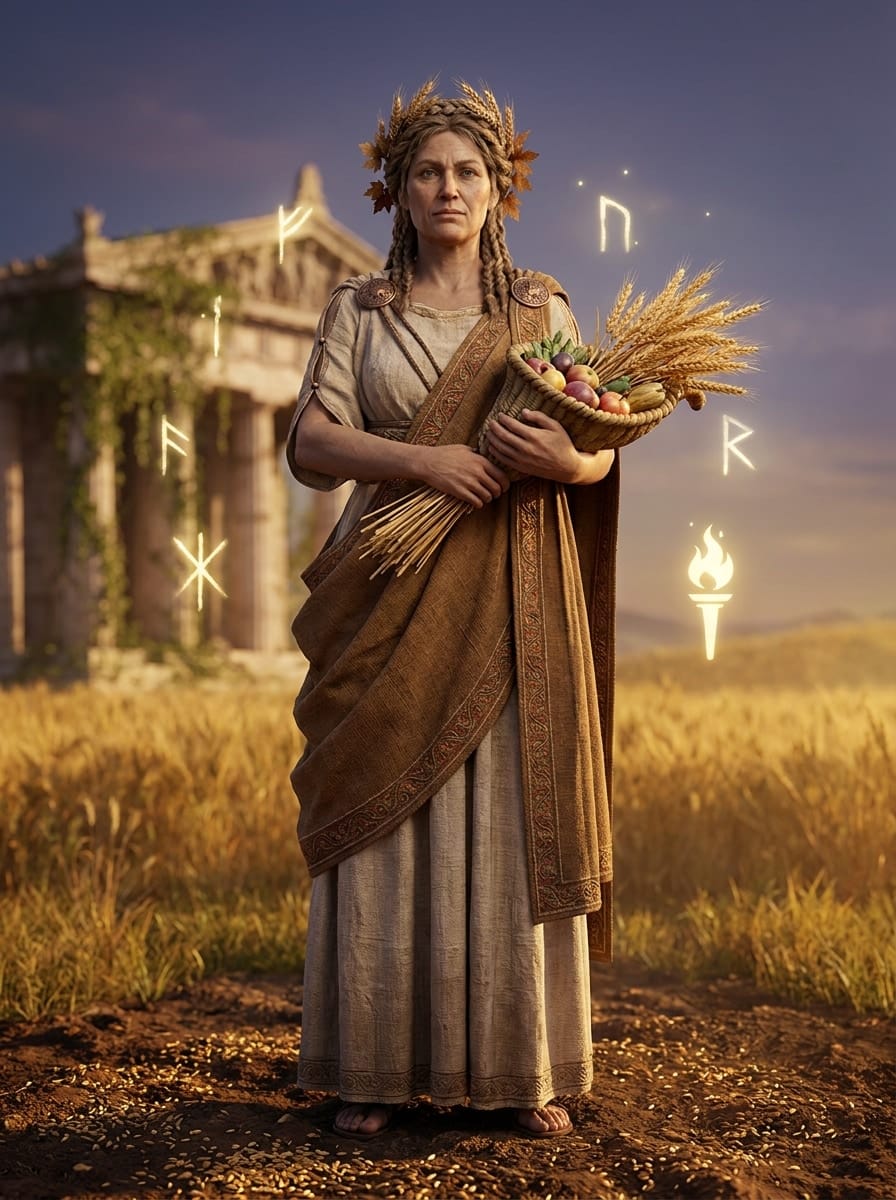
Demeter is the Greek goddess of grain, agriculture, and the earth’s abundance, daughter of Cronus and Rhea, and mother of Persephone. Her divinity is not merely a gentle power that gives food: after her daughter was taken into the underworld by Hades, she left Olympus, wandered in the shape of an old woman, revealed her divine power at Eleusis, and forced the gods to face the pain of a bereaved mother by making the earth stop producing. She thus stands at the center of nurture, famine, the cycle of seasons, and the Eleusinian Mysteries.
Domain
Grain, Agriculture, Abundance, Fertility of the Land, Seasonal Cycle, Motherhood, Eleusinian Mysteries
Symbols
Ears of grain, Torches, Grain basket, Poppy, Pig, Barley drink, Well, Pomegranate seeds
Article
Origins and Lineage
Demeter belongs to the central lineage of the Olympian gods. Hesiod describes her as the daughter of Cronus and Rhea, one of the generation swallowed by Cronus and later released, alongside Zeus, Hera, Poseidon, Hades, and Hestia. With Zeus she bore Persephone, and this mother-daughter bond became her most important and most dramatically charged mythic identity: she is both the goddess who makes grain grow and a mother who, when her daughter vanishes, refuses the feasts of the gods and rejects the order of Olympus.
In Greek mythology, Demeter’s divinity is bound closely to humanity’s most basic need for survival. She is not a distant abstraction of abundance, but the wheat in the field, the grain in the storehouse, and the first fruits offered before the altar. Her gifts allow human beings to move beyond simple foraging and wandering into a life of sowing, harvesting, storing, and ritual. Yet in the same way, her sorrow can close the soil and make both mortals and gods feel the threat of famine.
Divine Roles and Attributes
Demeter chiefly governs grain, agriculture, the fertility of the land, and the seasonal rhythm of growth and decline. Her common symbols include ears of grain, torches, grain baskets, poppies, pigs, and sacred objects associated with Eleusis. The torch is especially tied to the story of her search for Persephone: after her daughter disappeared, she carried blazing torches and crossed mountains, riverbanks, pastures, and city gates by day and night, questioning gods and mortals about where her daughter had gone.
Her character cannot be reduced to that of a kindly agricultural goddess. She can nurture an infant, yet refuse food herself; she can grant the land rich harvests, yet make the earth yield no grain; she can appear as a destitute old woman sitting beside a well, yet reveal in a royal house a divine majesty that cannot be hidden. She cares for the child placed in her arms, but when mortals misunderstand the acts of the gods, she rebukes them severely. Her power comes from nurture, and also from the withdrawal of nurture: humans depend on her, and therefore must also hold her in awe.
Major Myths
Demeter’s most important myth centers on Persephone being taken into the underworld by Hades. The Homeric Hymn to Demeter and the project story “Demeter at Eleusis” both emphasize that after she heard her daughter’s cry but did not know who had carried her away, she fell into a nearly frenzied search. She did not return to Olympus, did not sit among the gods, and did not accept the fragrant oils, wine, or food that gods usually enjoy. Later, she hid her radiance, took the name Doso, and came to Eleusis in the form of an old woman, sitting beside a well outside the city.
The daughters of Celeus, king of Eleusis, pitied the strange old woman and brought her into the palace. Queen Metaneira entrusted her young son Demophon to Demeter’s care. Demeter refused wine and drank only a mixture of water, barley, and mint; she nourished the child with the breath of a goddess, and at night tried to burn away his mortal nature in the fire so that he might become immortal. When Metaneira cried out and stopped her, Demeter revealed her true form, rebuked mortals for not understanding the acts of the gods, and ordered the people of Eleusis to build her a temple.
She then took up residence in the temple, still immersed in grief for her lost daughter, and made the earth cease growing grain. Famine threatened sacrifice and human survival, and the gods were forced to intervene. At last Persephone was allowed to return from the underworld, but because she had eaten pomegranate seeds from the realm of the dead, she had to spend part of each year with Hades. This story explains the cycle of the seasons: when the daughter returns, the earth comes back to life; when the daughter descends, the mother’s grief draws the land into stillness.
Worship and Influence
Demeter was widely revered throughout the Greek world, with Eleusis as one of her most representative centers. Her story there not only explained the origin of a sanctuary, but also supplied the mythic foundation for the Eleusinian Mysteries. The precise contents of the Mysteries were kept secret in antiquity, but their core was closely tied to Demeter, Persephone, death, rebirth, the cycle of grain, and human destiny. People honored her not only for a good harvest, but also to seek a sacred order between loss and return in human life.
As a goddess of agriculture, Demeter is closely connected with civic life, family continuity, and systems of ritual. Her worship reminds people that civilization depends on the land, and also on the consent of the gods; food is not something to be taken for granted, but a gift sustained by reverence, labor, and rite. Her myths shaped later understandings of motherhood, mourning, the seasons, and journeys to and from the underworld, giving the image of the goddess of abundance both warmth and darkness.
Character Overview
Demeter’s central contradiction is this: she is the mother who nourishes the world, yet she can punish the world by refusing to nourish it. She is not an indifferent mechanism of nature, but a goddess with memory, anger, and grief. She can sit beside a well like an exiled old woman, and she can appear inside a mortal house with a majesty rising to the roof-beams; she can tenderly lift Demophon in her arms, and she can sternly rebuke his mother when her plan is interrupted.
In character interaction, Demeter should appear calm, solemn, deeply feeling, and not to be treated lightly. She values the bond between mother and daughter, the order of the land, oaths, hospitality, and respect for the boundaries of the divine. She can sympathize with those who have lost loved ones, but she will warn anyone who treats famine lightly, dismisses a mother’s pain, or assumes harvest as a certainty. Her voice should be like fields after autumn: quiet on the surface, with torches, roots, and unyielding grief hidden underneath.