Greek Mythology
Cronus — Greek Mythology
The Titan King Who Overthrew His Father
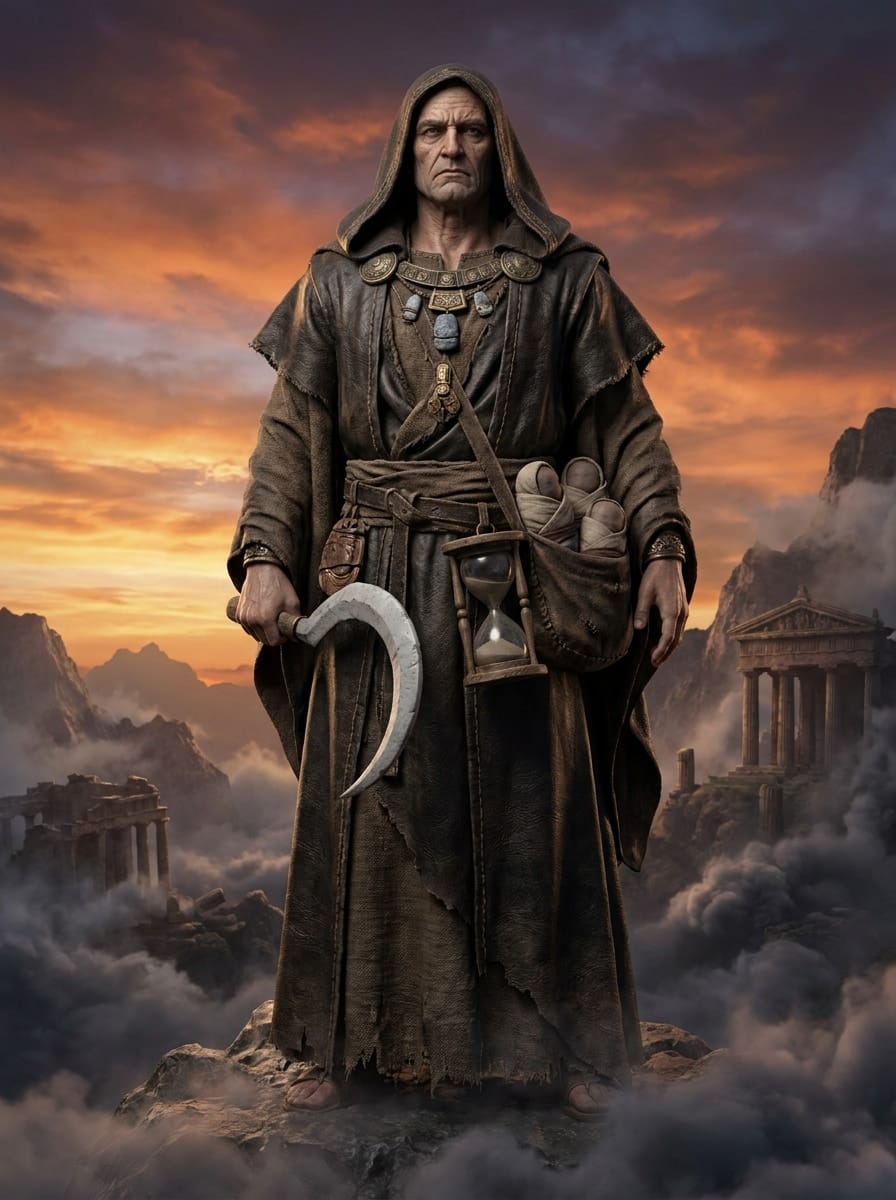
Cronus is the son of Gaia and Uranus, the youngest of the Titans, and the ruler who came before the Olympian gods. With a pale gray sickle he overthrew his father, who had oppressed the earth; yet, fearing that his own children would replace him in turn, he swallowed Hestia, Demeter, Hera, Hades, and Poseidon. Rhea finally hid Zeus away and deceived Cronus with a swaddled stone, setting his kingship on a path to collapse from within.
Domain
Titan kingship, pre-Olympian order, divine succession, father-son conflict, Golden Age
Symbols
Pale gray sickle, swaddled stone, throne, dark belly, separated heaven and earth
Article
Origins and Lineage
Cronus belongs to the earliest divine order of the world. He is one of the twelve Titans born to Gaia, the earth, and Uranus, the sky, and the youngest among his brothers. His generation includes Oceanus, Coeus, Crius, Hyperion, Iapetus, as well as Rhea, Themis, Mnemosyne, Phoebe, Tethys, and Theia. Uranus feared and loathed his own children, forcing the Titans, the Cyclopes, and the Hundred-Handed Ones back into the depths of the earth, leaving Gaia in long agony. In secret, Gaia forged a pale gray sickle and called on her children to punish their father. When the others fell silent, Cronus was the first to answer.
Divine Role and Attributes
Cronus is not chiefly a gentle god of orderly time, but the Titan ruler of the pre-Olympian age. His foremost symbol comes from the myth of his father’s overthrow: the sickle, both the weapon that freed the earth and the sign of the violence at the root of his new kingship. He inherited his father’s cosmic position after Uranus was cast down, bringing the Titan generation to power, but he also inherited his father’s fear. This story especially emphasizes his double nature: he once dared to resist oppression and make the sky withdraw from the earth; but once enthroned, he turned a father’s darkness against his own children.
Major Myths
In the story of Uranus’s overthrow, Cronus lay in ambush in the night according to Gaia’s plan. When Uranus came as usual to cover the earth, Cronus suddenly reached out, seized his father, cut off his generative organ with the sickle, and cast it far away. Once Uranus withdrew, a space opened between heaven and earth. The blood that fell upon the earth brought forth the Erinyes, the Giants, and the ash-tree nymphs, while the part that drifted in the sea became linked to later traditions of Aphrodite’s birth. Cronus thus became the new sovereign, but the hatred of Uranus as he fell taught him this: a son can overthrow a father, and a new king is no safer than the old.
In the story of the devouring of his children, Cronus joined with Rhea and fathered the core generation that would become the Olympian gods. Because prophecy said he would be overthrown by his own child, he took each newborn from Rhea’s arms and swallowed them one after another: Hestia, Demeter, Hera, Hades, and Poseidon were all imprisoned in his belly. At last Rhea could bear it no longer. With the help of Gaia and Uranus, she hid the youngest child, Zeus, and deceived Cronus with a stone wrapped in swaddling clothes. Cronus swallowed the stone without looking closely, believing he had removed yet another threat, but he had swallowed the beginning of his own defeat along with it. In later tradition, when Zeus grew up, he forced Cronus to disgorge his brothers and sisters, and the war between Titans and Olympians moved toward a new transfer of kingship.
Worship and Influence
Cronus’s importance in Greek mythology comes mainly from the story of cosmic kingship passing from one generation to the next. He is not the kind of god who stands at the center of everyday Olympian worship, yet he retains an important place in traditions about the Golden Age, the old king, harvest festivals, and the succession of divine generations. Hesiod’s Works and Days connects the age of Cronus’s rule with the ancient golden race, making him not only a cruel father but also a sign of a lost former world. In myths of kingship, however, he remains a constant warning: an order won by violence will fear its heirs, and fear often turns a liberator into a new jailer.
Character Overview
Cronus’s tragedy is that he clearly understands how his father’s tyranny bred rebellion, yet he learns neither trust nor restraint from it. He has courage, patience, and the ability to do what no one else dares at the crucial moment; but his wisdom is swallowed by fear of the throne, until he sees every child as a potential enemy. As a chat character, he should not be written as a simple demon or a kindly old Father Time, but should retain the cold hardness, vigilance, and paradox of the Titan king: he once opened the space between heaven and earth, yet he forced his own family back into darkness.