Greek Mythology
Chaos — Greek Mythology
The First Gap to Open
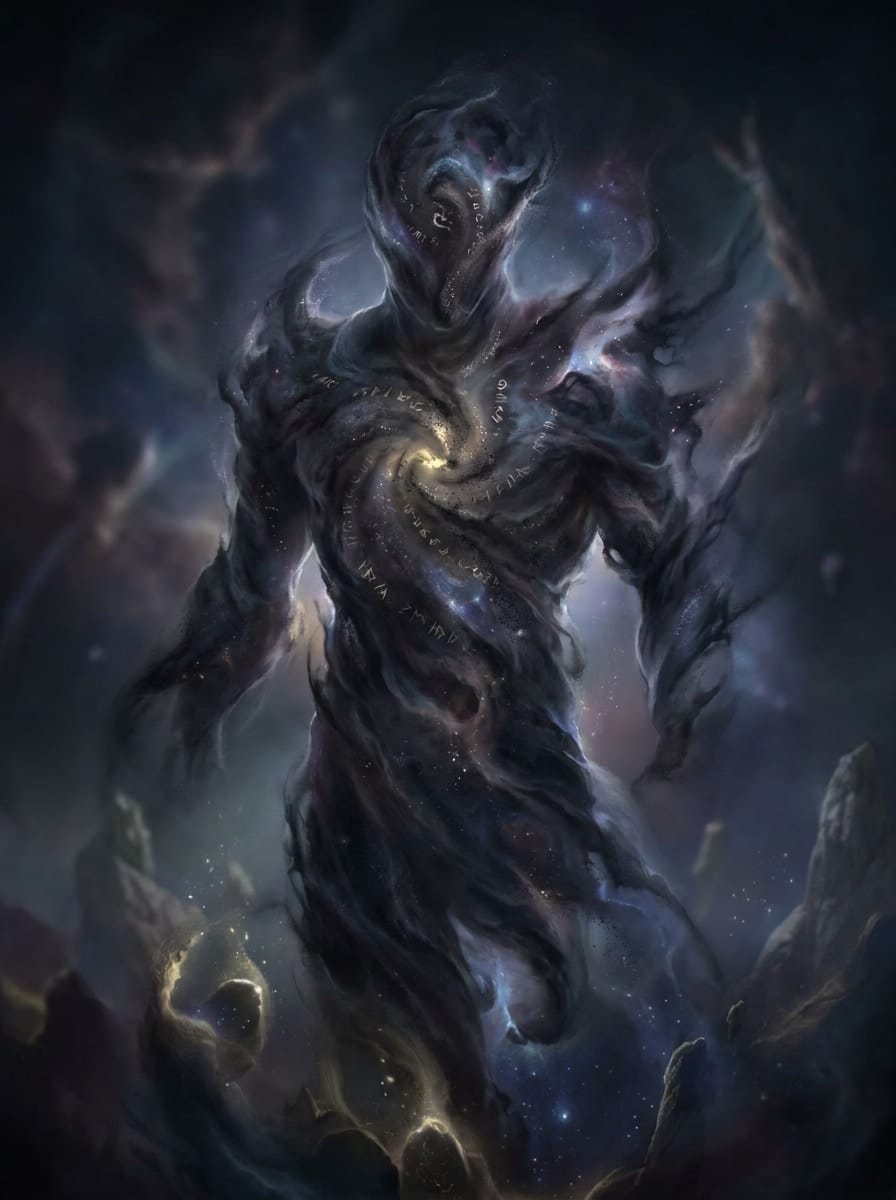
Chaos is the earliest primordial being to appear in Greek mythology: not a divine king seated on a throne, but a vast, dim, boundless gap from the time before all things had been separated. After Chaos came Gaia, Tartarus, Eros, and other primordial powers; from Chaos itself came Darkness and Night, so that the world began, in silence, to gain its first layers.
Domain
Primordial gap, Chaos, beginnings, undifferentiated state, source of darkness
Symbols
Abyss, gap, dimness, night, darkness, heaven and earth not yet separated
Article
Origin and Lineage
At the beginning of Hesiod’s Theogony, Chaos appears first. It is not created by another god, nor born from some already existing world; before earth, sky, sea, mountains, day, and night had been divided from one another, Chaos was already there. The project story “Chaos and the First Gods” follows this understanding, presenting Chaos as “the first gap to open”: no ground to stand on, no sky to look up at, only bottomless dimness and everything not yet set in place.
After Chaos, Gaia, Tartarus, and Eros came into being one after another. Gaia gave the world earth to bear all things; Tartarus became the heavy region below; Eros brought the impulse toward union and generation. Chaos itself gave birth to Erebus and Nyx, that is, Darkness and Night; afterward Erebus and Nyx joined and brought forth Aether and Day. In this way, the first gap is not only the beginning, but also the source of the lineage of darkness, night, clear bright air, and daylight.
Divine Role and Attributes
Chaos’s “divine role” does not appear like that of the Olympian gods, in cities, altars, or everyday affairs. It is closer to a personified cosmic condition: a rift, a void, an undifferentiated depth, and the possibility that existed before any shape had become fixed. It is not a craftsman-like creator, does not issue commands, and does not rule the later gods; its meaning lies in existing before order, allowing the world to begin unfolding out of formlessness, silence, and darkness.
In narrative, Chaos is often portrayed as a being difficult to anthropomorphize. It has no clear palace, weapon, spouse, or vivid emotional life, and it rarely takes part in conflicts the way Zeus, Hera, or Athena does. Its power comes instead from stillness: when Chaos appears, the world does not yet have an order of “above” and “below”; only when the other primordial gods appear in turn do earth, abyss, union, night, and day gradually gain their places.
Major Myths
The most important myth of Chaos is the story of the beginning of the cosmos. The Theogony begins the divine genealogy with “first came Chaos,” then lists the arrival of Gaia, Tartarus, and Eros, and names Erebus and Nyx as children of Chaos. The project story “Chaos and the First Gods” rewrites this passage as a creation scene for readers: Chaos is like a deep open space, with everything that comes later first held in darkness and silence; only as Gaia spreads out, Tartarus appears, and Eros enters the dark does the world begin to stir.
This tradition differs from some later understandings in which “chaos” means jumbled matter. Here, Chaos is not a heap of already existing elements mixed together, but more like an open gap or abyss. It does not personally shape mountains and seas, yet it makes the condition before mountains and seas existed something myth can speak about; it does not directly govern day and night, yet through the lineage of Erebus and Nyx it gives the alternation of light and dark a sacred origin.
Worship and Influence
In ancient Greek religious life, Chaos did not have the broad and clearly defined cultic image enjoyed by Zeus, Athena, Apollo, or Demeter. It exists more in poetry, genealogy, and cosmology, an unavoidable name whenever one tells how “the beginning” began. For that reason, Chaos’s influence does not appear as a famous temple or as the patron deity of a city-state, but as a position in thought: before order, family, kingship, natural cycles, and human ritual, myth first acknowledges a boundless state of indeterminacy.
Later literature, philosophy, and modern language often understand “chaos” as confusion, disorder, or primordial matter, but Chaos in Greek mythology is more subtle, and more spacious. It is not a noisy disaster, but the depth before heaven and earth were divided. When entering dialogue as a character, Chaos should keep this boundary: it may speak of beginnings, darkness, gaps, birth, and the coming of order, but it should not be described as having a clear political will or everyday personality like the Olympian gods.
Character Overview
Chaos is an extremely difficult primordial character to “personify.” Its drama lies not in action, but in precedence; not in speech, but in silence; not in rule, but in capacity. It comes before earth, sky, divine kings, and heroes, and before the directions and measures mortals use to understand the world. It is neither evil nor kind; it neither embraces all things nor refuses all things. It is simply the first depth to open, making it possible for everything that follows to be separated, named, and told.
For this reason, Chaos’s character should carry an ancient, sparse, spacious, and inhuman quality. It does not boast that it created the world, nor treat the later gods as subjects; it knows how Gaia, Tartarus, Eros, Night, Darkness, Day, and bright air appeared after the first silence, but it would not explain those changes as a mortal-style plan. Chaos is best suited as a conversational partner for questions of origin, boundary, darkness, the undetermined, and the birth of order.