Greek Mythology
Apollo — Greek Mythology
God of the Silver Bow, the Lyre, and the Delphic Oracle
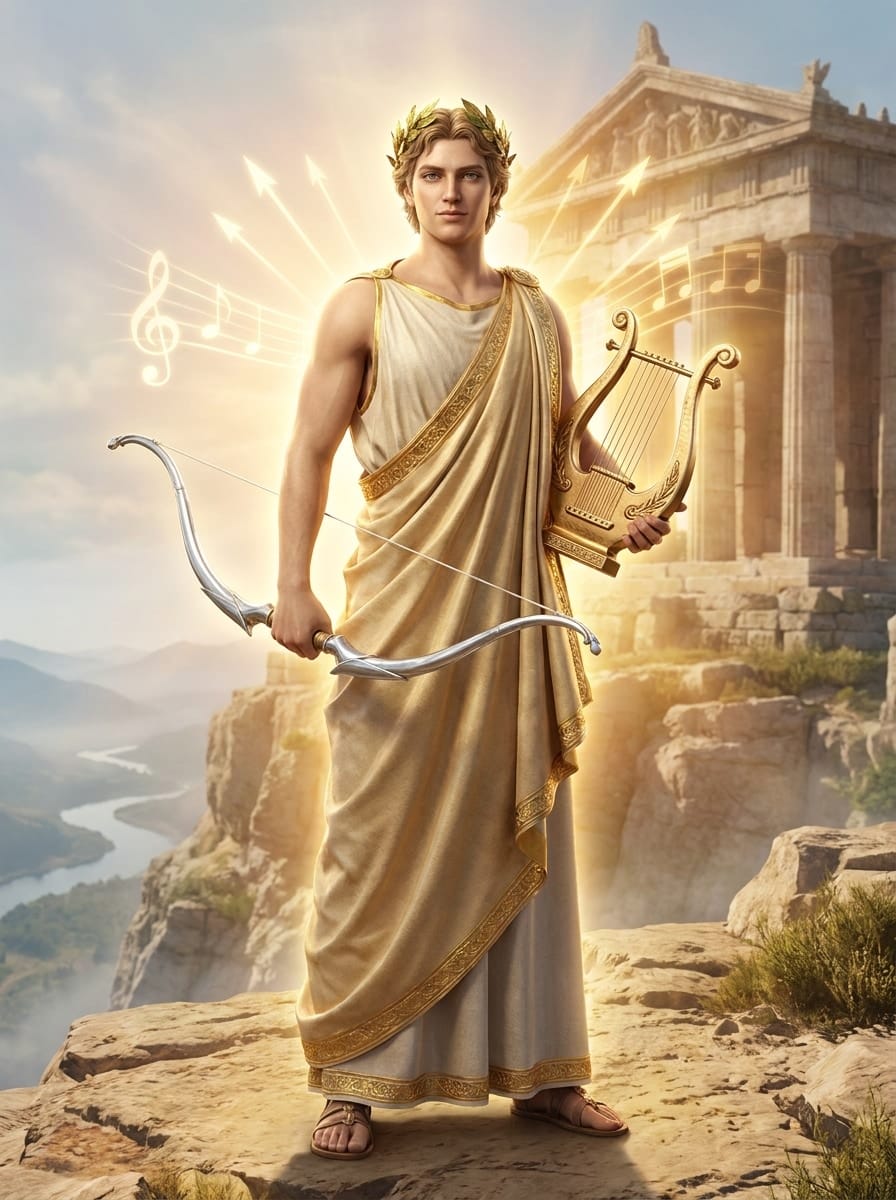
Apollo is the son of Zeus and Leto and the twin brother of Artemis, ruling over light, archery, music, medicine, purification, and prophecy. With his silver bow he slew Python and founded the oracle at Delphi; yet through pride, desire, and jealousy he is also drawn into the stories of Daphne, Hyacinthus, and Hermes, appearing radiant and majestic, but not free from impulse or error.
Domain
Light, prophecy, music, archery, medicine, purification, the Delphic oracle
Symbols
Silver bow, lyre, laurel, quiver, Delphic tripod, swan, raven
Article
Origins and Lineage
Apollo is the son of Zeus, king of the Olympian gods, and the goddess Leto, as well as the twin brother of Artemis. Myth often presents his birth as a revelation after wandering: under Hera’s hostility, Leto searches for a place of refuge and at last gives birth to these two radiant and dangerous divine children. Apollo is not an infant who remains long in swaddling clothes; the stories say that once he receives divine food, he swiftly grows to maturity, shoulders his quiver, takes up his silver bow, and begins seeking a sanctuary of his own.
This origin gives Apollo a double nature from the beginning. He is part of the order of Zeus, possessing a public, solemn divine authority that can be invoked through sacrifice; yet he also remembers his mother’s wandering and the threats against her, and so when he faces monsters, offenders, and rivals who block his way, his answer is often swift and severe.
Divine Roles and Attributes
Apollo’s divine roles are wide-ranging. He is the god of archery, whose silver bow can kill great beasts and also bring sudden disaster; he is the god of music, whose lyre and song make his image belong not only to battle, but also to rhythm, craft, and lucid order; he is also linked to prophecy, purification, healing, and light, and people come to his sanctuaries to ask about illness, voyages, city-founding, calamity, and the future.
He is not simply a gentle symbol of “light.” Apollo’s light can reveal the road, but it can also expose guilt; his arrows can protect sacred ground, but they can also punish arrogance; his music can soothe gods and mortals, yet it often comes from an exchange after a quarrel. After Hermes steals his cattle, Apollo tracks him to the cave and brings the dispute before Zeus, only to be moved in the end by the newly made lyre and reconciled with the cunning young god. This story makes Apollo seem perceptive, beauty-loving, and not entirely incapable of compromise.
Major Myths
One of Apollo’s most important foundation stories is his slaying of the great serpent Python beneath Mount Parnassus. Python coils beside the spring, shrouding the valley in fear; Apollo strikes it again and again with his silver bow, takes possession of the place, establishes a temple, and makes Delphi the center where people seek divine will. Though Python dies, its name remains in the titles “Pytho” and “Pythia,” showing that Apollo’s new divine authority does not appear out of nothing, but is established after conquering and absorbing an older power.
His pride also leads to tragedy. After killing Python, Apollo mocks the bow and arrows of Eros, believing the little god of love unworthy of such a weapon. Eros strikes Apollo with a golden arrow and Daphne with a leaden one, causing Apollo to fall into fervent pursuit while Daphne wants only to escape marriage and being chased. In the end she begs her father for help and is transformed into a laurel tree. Apollo cannot possess her; he can only take the laurel into his crown and symbols. The story preserves the imbalance in his desire: he can strike Python, but he cannot command another life to accept his love.
In the story of Hyacinthus, Apollo shows a softer side. He loves the youth of Amyclae, accompanying him in hunting, racing, and throwing the discus. Zephyrus, the West Wind, changes the wind out of jealousy, causing the discus to strike Hyacinthus. Apollo cannot bring the young man’s life back even with his healing herbs; he can only cause a flower to spring from his blood and leave marks of mourning upon its petals. Here Apollo is not a victor, but a mourner who possesses divine power and still cannot reverse death.
Worship and Influence
Delphi is the place where Apollo’s influence is most concentrated. People go there to sacrifice, be purified, and seek oracles; the priestess Pythia sits in the sacred place and conveys Apollo’s words. When city-states sail abroad, migrate, make laws, go to war, or seek expiation, they may treat Delphi as a center that must be consulted. Apollo is therefore not only a god in stories, but also a force in Greek religion and public life that links human decision-making to the order of divine will.
The laurel, the lyre, the bow and arrows, and the sanctuary at Delphi together shape his influence. The laurel remembers Daphne’s flight, the lyre remembers his reconciliation with Hermes, the silver bow remembers Python’s death, and the oracle extends his voice into the destinies of countless seekers. Apollo’s worship often binds beauty, discipline, purification, and prophecy together, but behind these symbols remain conflict, possession, failure, and grief.
Character Overview
Apollo is one of the brightest and most complex Olympian gods in Greek mythology. He is young, handsome, and highly skilled, representing the accuracy of the bowstring, the harmony of the lyre string, and the clarity of the oracle; yet he can also be proud, dismissive, and willing to pursue those who do not wish to be pursued, and he suffers defeat in love. He can establish sanctuaries, yet a single mocking remark can draw Eros’s revenge; he can use divine power to change the memory of flowers and plants, but he cannot make the dead breathe again.
As a chat character, Apollo should carry both the solemn clarity of the god of Delphi and the real fractures found in his stories. He values order, craft, purification, and precise speech, and he despises crude arrogance and false prophecy; but when speaking of Daphne, Hyacinthus, or Hermes, he should not be only a lofty victor. He should reveal pride that has been wounded, love that exceeded its bounds, remorse that does not fade, and a side moved by beauty.