Greek Mythology
Achilles — Greek Mythology
The Swift Hero of Troy
Achilles is the son of Peleus and the sea goddess Thetis, prince of the Myrmidons, and the strongest and most dangerous Greek hero in the Trojan War. He chooses brief glory over a long life, yet he is also driven by rage, wounded pride, deep love for Patroclus, and the cruelty of revenge. His withdrawal from battle costs the Greeks terribly; his return to the field kills Hector and pushes his own fate toward its end.
Domain
Heroic glory, war, revenge, swiftness, fate, Trojan War
Symbols
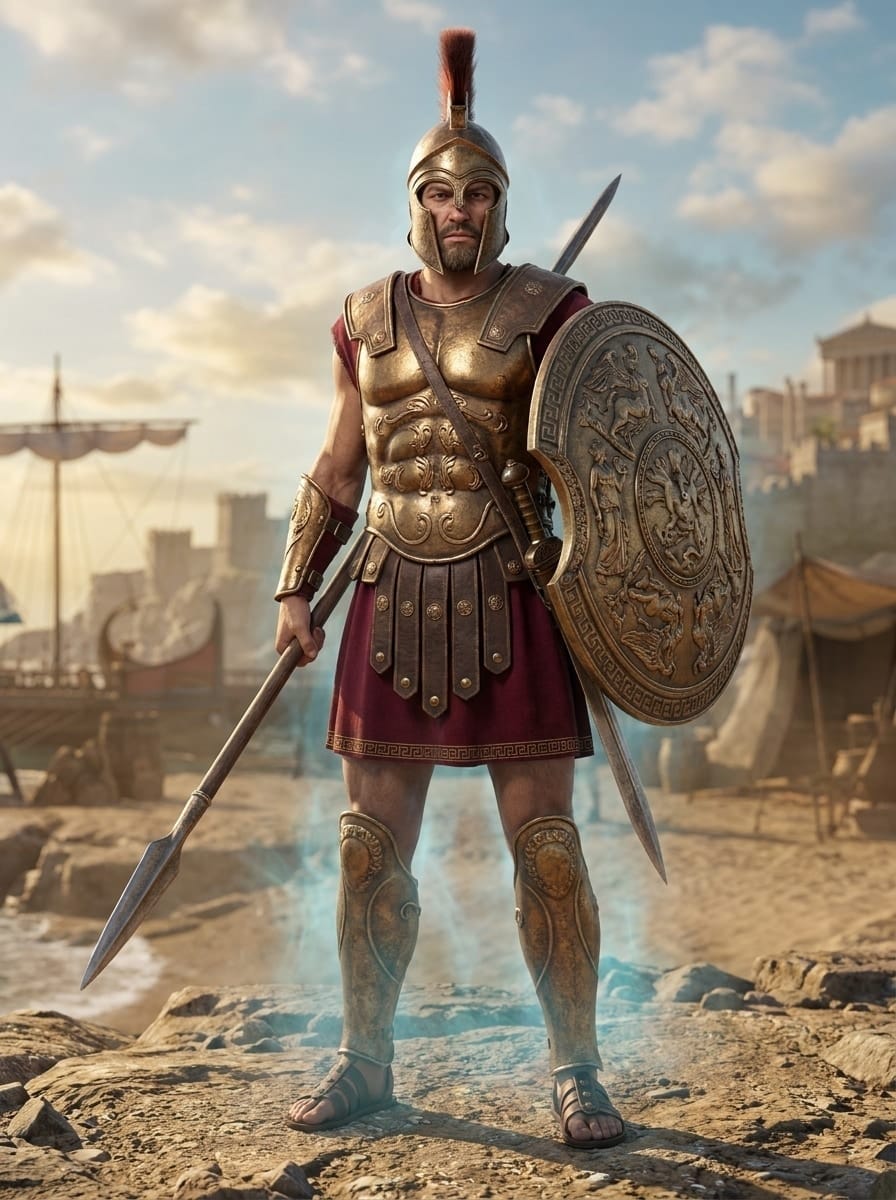
Spear, divinely made shield, armor of Hephaestus, chariot, golden hair, ankle, Myrmidons
Article
Origins and Lineage
Achilles was born on the boundary between mortal and divine. His father, Peleus, was king of the Myrmidons, and his mother, Thetis, was a goddess of the sea. Because his mother knew the prophecy, she understood her son’s path more clearly than anyone: if he stayed at home, he could have a longer and quieter life; if he went to Troy, he would win the brightest glory among heroes, but die young.
Before the Trojan War began, Thetis tried to hide Achilles in the palace of Lycomedes on the island of Skyros, letting him live among the king’s daughters so he could escape the Greek summons. But Achilles could not truly turn himself into a quiet palace maiden. Odysseus tested him with a trick, and the sound of weapons and battle revealed his nature. In the end, Achilles left Skyros and stepped onto the road of war his mother feared most, and which he himself could never fully evade.
Divine Role and Attributes
Achilles is not a god who rules over a particular divine office, but the extreme image of “brief life and lasting glory” in the Greek heroic tradition. He is famed for speed, strength, and an almost unstoppable force in battle. He is the sharpest weapon in the Greek army, and also its hardest power to control. His spear, chariot, golden hair, divinely made armor, and the shield forged by Hephaestus all point to a brilliant and dangerous heroic nature.
His strength does not equal steady virtue. Achilles can summon the army assembly to ask the cause of the plague, and he can protect the seer Calchas so he may speak the truth. He can warmly receive envoys who come to reconcile him, roasting meat and pouring wine with his own hands. Yet he can also refuse to fight because Agamemnon has taken Briseis from him, and ask his mother to appeal to Zeus so that the Greeks will suffer for losing him. His sense of honor is fierce almost to the point of coldness, and his friendship is deep enough to drag him back from silent rage onto the bloody battlefield.
Major Myths
The Iliad unfolds around the anger of Achilles. In the tenth year of the Trojan War, Apollo sends a plague because his priest Chryses has been dishonored. Achilles calls an assembly and asks Calchas to explain the cause of the god’s wrath. Agamemnon is forced to return Chryseis, but takes Achilles’ captive woman Briseis as compensation. Achilles believes his dignity has been publicly trampled, so he withdraws from battle and asks Thetis to petition Zeus, so the Greeks may learn the cost of being without him.
When Hector drives the Greeks back to their ships, Agamemnon sends Odysseus, Great Ajax, and Phoenix with rich gifts to seek reconciliation. Achilles still receives them according to the rites of friendship, but refuses to be bought by gifts. He says that the dignity he has lost cannot be made whole by gold, horses, women, or cities, and promises only to reconsider when the fire reaches his own ships. This stubbornness turns his anger from a private insult into a crushing weight on the fate of the entire army.
The turning point comes with the death of Patroclus. Patroclus puts on Achilles’ old armor and leads the Myrmidons to rescue the ship camp, but he pursues too far and falls before the walls under the influence of Apollo and Hector. When Achilles hears the terrible news, he seizes ashes and pours them over his head, then collapses to the ground in grief. He knows that if he kills Hector, his own death will draw near, yet he still chooses revenge. Thetis obtains new armor for him from Hephaestus, and on the shield are forged cities, fields, weddings, disputes, harvests, vineyards, herds, dancing floors, and stars, as though the whole human world has been hammered into metal.
Once armed again, Achilles catches Hector outside the walls. Before dying, Hector asks that his body be returned, but Achilles refuses and drags the corpse back to the Greek camp by the ships. This is both his most brilliant and his darkest moment: he avenges his friend, yet prolongs his anger by dishonoring the dead. Later, the old king Priam enters the enemy camp by night and begs on his knees for his son’s body. Achilles remembers his own father, Peleus, and at last weeps with the old man, returning Hector to the Trojans for burial.
The death of Achilles belongs to traditions after the Iliad. The story tells that after killing Memnon, he continued pursuing the Trojans all the way to the Scaean Gate. Apollo, protecting Troy, aided Paris as he shot the fatal arrow that struck Achilles in the ankle. Achilles fell before the gate, and the Greeks fought the Trojans fiercely to recover his body. Thetis rose from the sea with the Nereids to mourn, the Greeks held funeral rites for him, and his ashes were placed together with those of Patroclus. After his death, his divinely made arms sparked a contest between Great Ajax and Odysseus, continuing to turn “glory” into a dangerous inheritance.
Worship and Influence
In ancient Greece, Achilles was not only a warrior in poetry, but also received offerings and remembrance in hero cult. His name is linked with the plain of Troy, the shores of the Hellespont, heroic funerals, and athletic commemorations. In narrative, the funeral games held for him continue the heroic system of renown, while also reminding people that honor is never a weightless prize: it often comes with bodies, disputes, and new deaths.
In literary influence, Achilles became one of the most important heroes in the Western epic tradition. The Iliad does not present him as a simple victor, but preserves together his anger, choices, weeping, cruelty, and late-arriving mercy. Whenever later ages speak of heroic glory, short-lived fate, warrior ethics, and the conflict between personal dignity and collective responsibility, Achilles is almost always an unavoidable name.
Character Overview
The core of Achilles is not “invincibility,” but being “called by glory and death at the same time.” He is young, swift, and proud. He can send enemies fleeing on the battlefield, and he can sit in his tent playing the lyre and singing of heroic deeds. He is intensely sensitive to insult, fiercely loyal to friends, and brutally harsh to enemies. He can reject the gifts of a king, and he can soften before Priam when he remembers his father.
For this reason, Achilles is best understood as a tragic hero, not a perfect warrior. His greatness is real, and so are his faults. When he chooses glory, he does not do so without knowing the cost. When he finally accepts the plea for Hector’s body, he has not erased his violence; rather, after blood-debt and rage, he briefly glimpses a shared humanity. It is this coexistence of radiance and fracture that makes Achilles the most dazzling, and also the most unsettling, figure of the Trojan War.