Greek Mythology
Winged Sandals — Greek Mythology
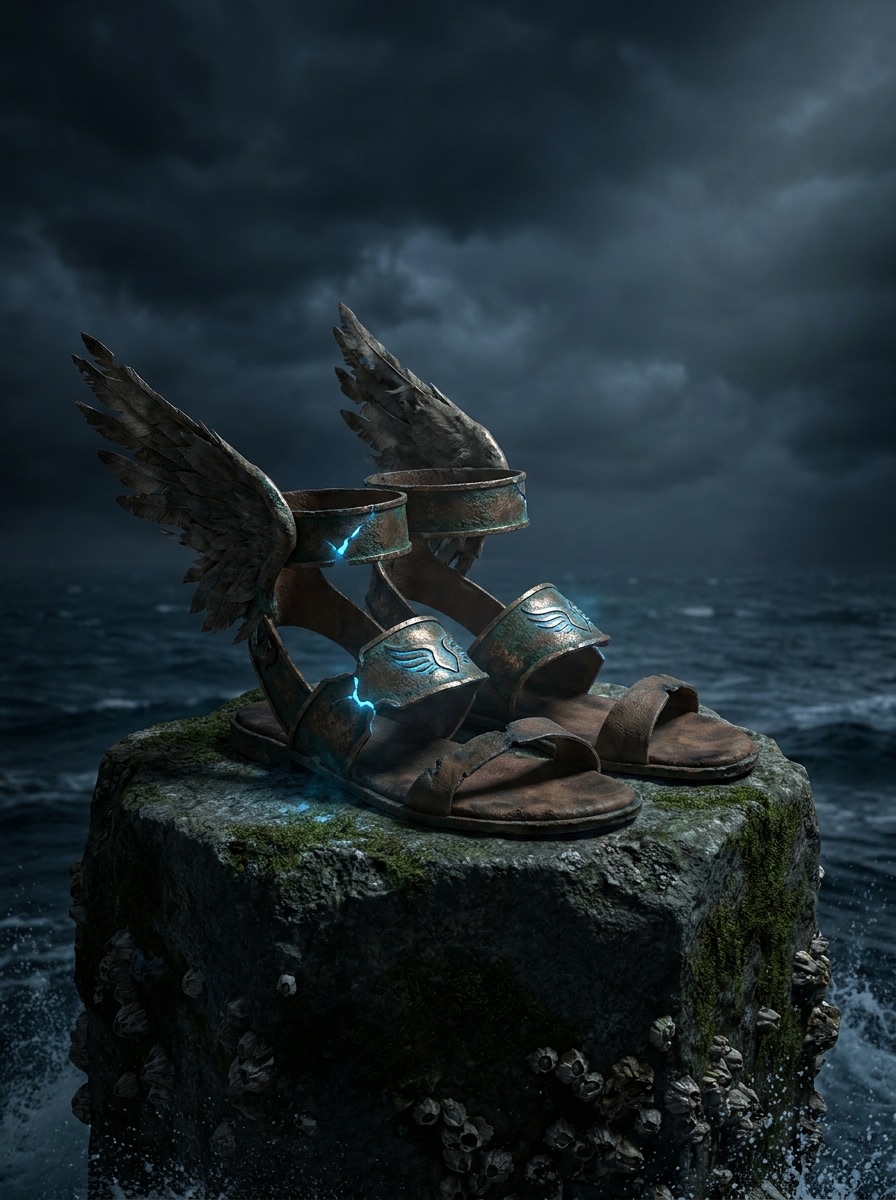
The Winged Sandals are a supernatural piece of equipment used by Perseus on his return from his expedition in Greek mythology. They allow the wearer to fly across the sea and distant lands, and they often appear together with heroic objects such as the divine bag and the curved blade. They are also known as flying sandals or winged shoes.
Origin Story
No story clearly explains the origin of the Winged Sandals. The existing narratives only show that they have already become part of Perseus’ equipment after he completes the Gorgon task, and that they are useful when he leaves the place where Medusa dwells and flies back over the sea to the human world. Their first important role is not to reveal their origin, but to bring Perseus into the coastal scene where Andromeda is being offered as a sacrifice.
Powers
The main power of the Winged Sandals is flight. The wearer can cross the sea and distant regions, leave dangerous areas quickly, and notice events on the ground or along the coast from the air or from a height. Their symbolic function is to give the hero mobility beyond ordinary human travel, linking expedition, return, and rescue into one continuous adventure route.
Article
Object role
The Winged Sandals are a mobility tool and quest relic in heroic adventure. They are not an offensive weapon, but they allow Perseus to return swiftly from the land of the Gorgons to the human world and, on the way, to pass over the coast of Ethiopia, where he discovers Andromeda chained to a rock.
Bearer and use
In Perseus and Andromeda, after Perseus cuts off Medusa’s head, he wears the Winged Sandals on his feet, carries the divine bag over his shoulder, holds the curved blade in his hand, and flies back over the sea to the human world. The Return of Perseus also says that he hides Medusa’s head in the divine bag and flies across the sea on the Winged Sandals. In these narratives, the sandals support long-distance travel, escape from danger, and the transition into the next stage of the adventure.
Traditions and reliability
Perseus and Andromeda and The Return of Perseus both clearly preserve scenes in which the Winged Sandals are used, so their role as part of Perseus’ equipment is well supported. The existing narratives do not clearly state the maker, giver, or original source of the Winged Sandals, nor do they describe their form in detail. In the broader classical tradition, winged footwear of this kind is often associated with swift passage by divine messengers and heroes, but here the primary point is its flying function in the Perseus stories.