Greek Mythology
Trident of Poseidon — Greek Mythology
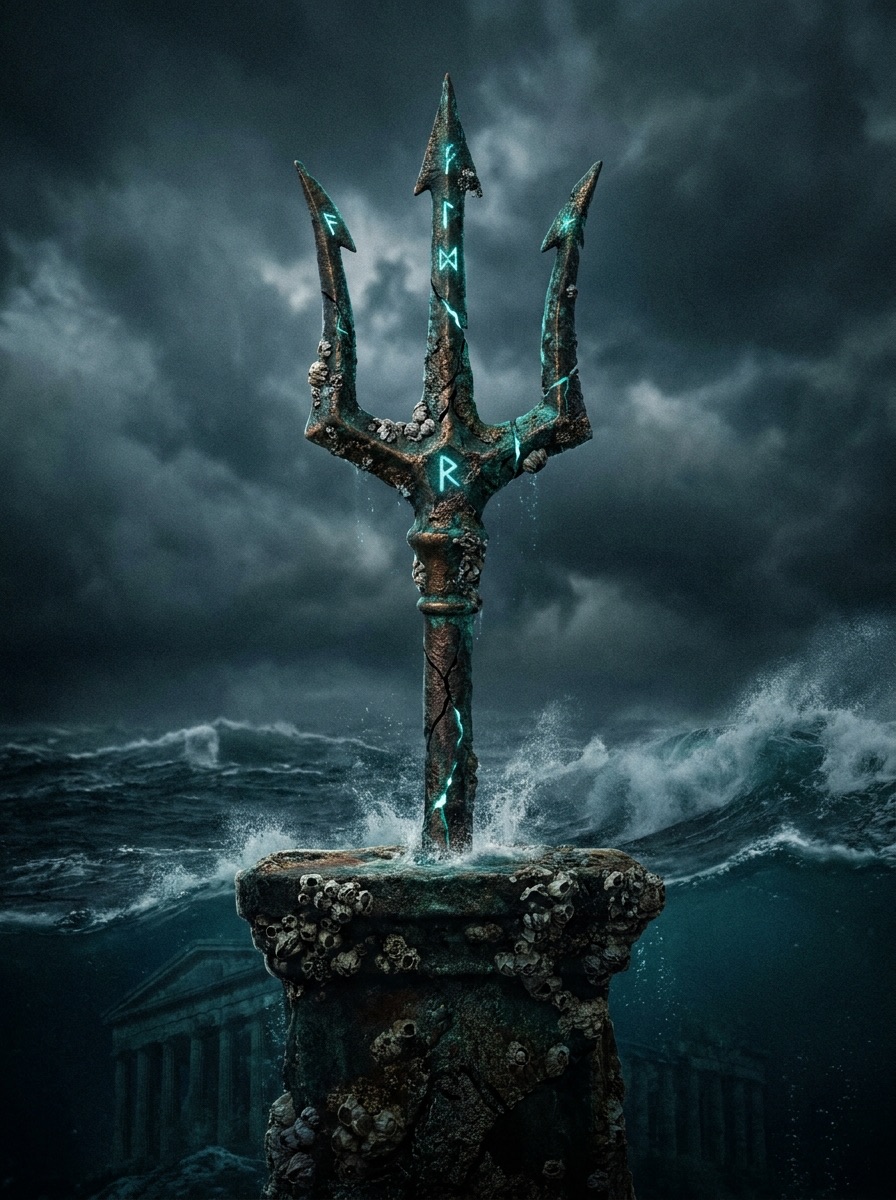
The Trident of Poseidon is the signature weapon of Poseidon, the sea god in Greek mythology. It is also known as the Sea God's Trident or Poseidon's Trident. It is closely associated with Poseidon's authority over the sea. In the contest for the naming rights of Athens, Poseidon struck open the rock with it, causing salt water to surge from the cleft.
Origin Story
The existing narrative materials do not clearly state who forged the Trident of Poseidon, nor do they recount how it first came into Poseidon's possession. In the stories, it already appears as Poseidon's established weapon. Its clearest use occurs in the contest over the naming rights of Athens: Poseidon strikes the rock open with the trident, displays the power of the sea god, and offers the resulting salt water as his gift to Attica.
Powers
The Trident of Poseidon can split rock open and make water surge from the earth. In the contest for Athens, it displays the power to shake the land, summon seawater, and awe the onlookers. As the sea god's signature weapon, it also symbolizes Poseidon's rule over the sea, his influence on coastal lands, and the authority of the Olympian gods over the forces of nature.
Article
Basic definition
The Trident of Poseidon is Poseidon's most representative divine artifact. Its form is usually understood as a long-handled weapon with three prongs. It is both a weapon and a sign of divine authority. In the Olympian order, Poseidon received the sea as his domain, so the trident is often regarded as a symbol of maritime rule, the power of wind and waves, and the majesty of the sea god.
Bearer and use
The trident's primary bearer is Poseidon. In Athena and Poseidon Contest for Athens, Poseidon came first to Attica, raised the trident, and struck open the rock, making water gush from the stone. The people marveled at the sea god's power, but the water that emerged was salty and could not truly relieve the city's thirst. Athena then offered the olive tree, and the gods judged that her gift was better suited to Attica.
Variant traditions and reliability
Athena and Poseidon Contest for Athens clearly preserves the scene in which Poseidon uses the trident to strike the rock and bring forth water, making it the direct narrative basis for this artifact. The Titan War and The Division of the World and the Olympian Order explain Poseidon's place in the Olympian divine order and his receipt of the sea as his domain, but they do not explain the trident's origin. In broader classical tradition, the trident often appears together with Poseidon's identity as sea god. Its specific maker, earliest bestowal, and full origin are not clearly stated in the existing narrative materials.