Greek Mythology
Shirt of Nessus — Greek Mythology
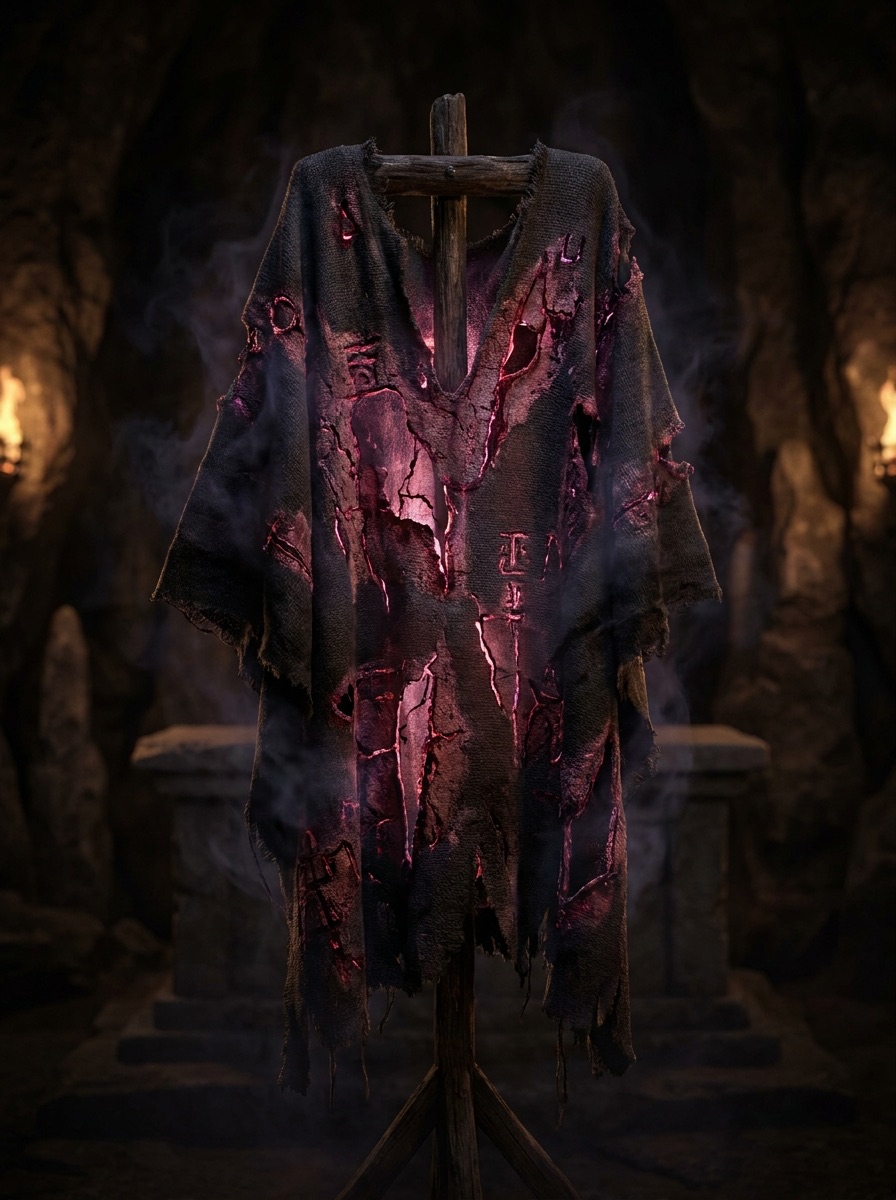
The Shirt of Nessus is a robe in Greek mythology stained with the poisoned blood of the centaur Nessus, and the fatal gift that brings about the destruction of Heracles’ mortal body. It is also known as Nessus’ blood-shirt, the poisoned-blood robe, and Heracles’ poisoned robe.
Origin Story
The origin of the Shirt of Nessus lies in the death of Nessus. When Heracles and Deianira were crossing a river, Nessus tried to carry Deianira off, and Heracles shot him dead with an arrow. As he was dying, Nessus did not admit his malice. Instead, he gave Deianira his blood and falsely claimed that it would make Heracles love her forever. Years later, Deianira smeared that blood on a robe, and the Shirt of Nessus was formed.
Powers
The Shirt of Nessus has no protective function. Its power comes from poisoned blood and deception: once heated, the robe’s poison reveals itself, biting into Heracles’ flesh, driving him into agonized frenzy, and leaving him unable to free himself. It does not grant strength directly. Instead, disguised as a token of love, it carries out punishment and revenge, ultimately forcing Heracles toward the funeral pyre on Mount Oeta and his apotheosis.
Article
Basic form
The Shirt of Nessus was originally an ordinary robe, but it became deadly after being smeared with the blood Nessus left behind at his death. Deianira believed Nessus’ words and thought the blood could preserve her husband Heracles’ love, so she applied it to the robe and sent it to Heracles.
Holder and use
In The Death and Apotheosis of Heracles, Nessus deceives Deianira as he is dying, claiming that his blood is a love charm. Later, when Heracles brings back Iole, Deianira becomes afraid and has the messenger Lichas deliver the blood-smeared robe to Heracles. Heracles puts on the robe while sacrificing to Zeus by the sea. When the sacrificial fire heats it, the poison takes effect, and the garment clings to his flesh so tightly that it cannot be torn away.
Traditions and reliability
The Death and Apotheosis of Heracles clearly states that the robe’s danger comes from Nessus’ blood, and also makes clear that Deianira did not intend to kill Heracles, but was deceived by Nessus’ dying words.
Deianira and Nessus provides the background to Deianira and Heracles’ marriage, but does not directly describe the making of the Shirt of Nessus.
In the broader Greek mythological tradition, the Shirt of Nessus is often treated as a classic example of a “dangerous gift”: outwardly a garment meant to restore love, but in reality a means of revenge left behind by Nessus after death.