Greek Mythology
Shield of Achilles — Greek Mythology
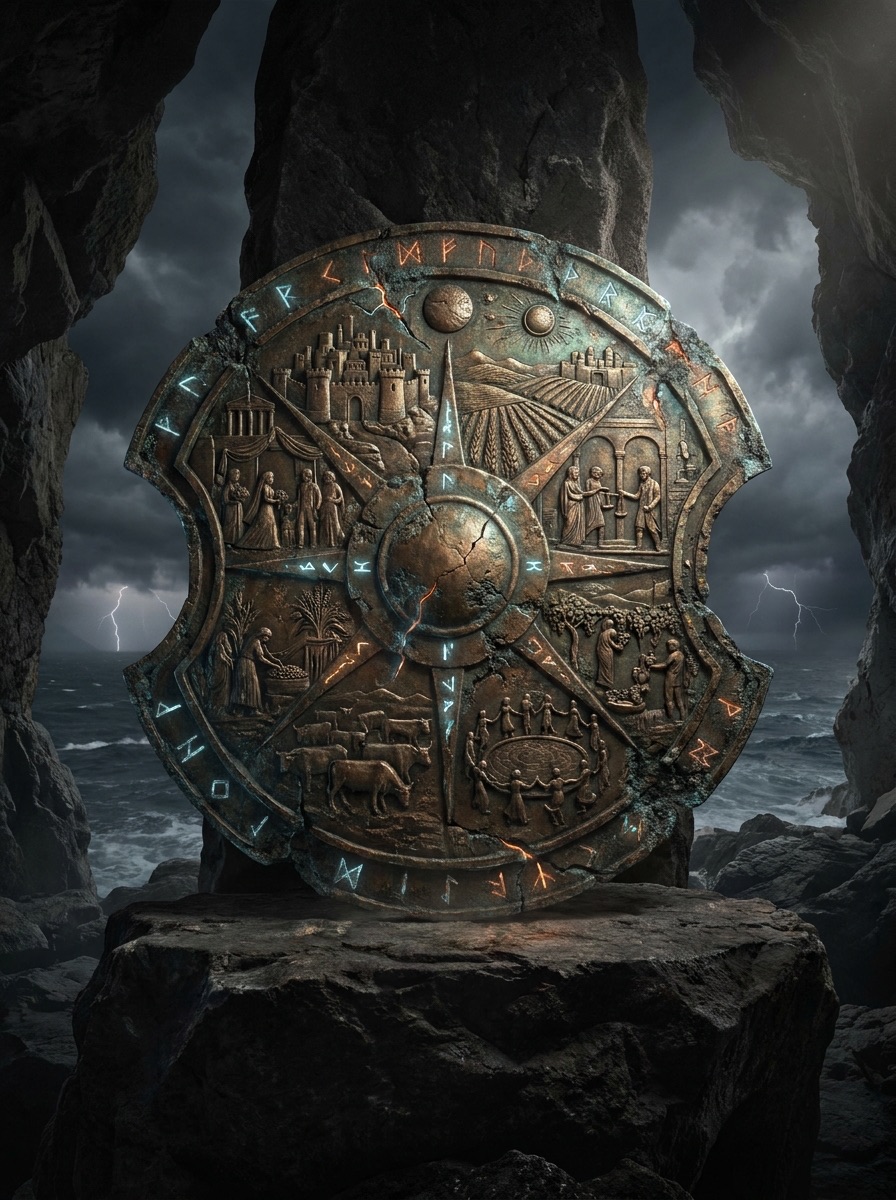
The Shield of Achilles is a divinely made shield from the Trojan War in Greek mythology. Hephaestus, god of fire, forged it for Achilles and gave it to him together with a new set of armor. Its surface is engraved with cities, fields, weddings, disputes, harvests, vineyards, cattle, a dancing floor, and the stars, and it is often regarded as one of the most famous pieces of war gear in Homeric epic.
Origin Story
The origin of the Shield of Achilles appears after the death of Patroclus. Patroclus had gone into battle wearing Achilles’ old armor, and after his death Hector took the armor. Achilles has no usable armor, but resolves to avenge his friend. Thetis therefore goes to the workshop of Hephaestus and asks him to forge new war gear for Achilles.
Beside the furnace, Hephaestus forges a complete set of equipment, the most famous part of which is this great shield. The next day, Thetis brings the shield and the new armor to Achilles. Made by the divine craftsman himself, the shield becomes the sign of Achilles’ return to the battlefield.
Powers
The Shield of Achilles is first of all defensive war gear, used to protect Achilles as he returns to battle. Forged by Hephaestus, it has the solidity and majesty of divine equipment. The images on its face display heaven and earth, human cities, farming, herds, dance, and the stars, giving it a strong cosmic symbolism. In the narrative, it suppresses fear, awes onlookers, and announces Achilles’ movement from grief into revenge.
Article
Basic image
The Shield of Achilles is the new shield Achilles receives after losing his old armor. Patroclus wears Achilles’ old armor into battle, is killed by Hector, and the armor is taken. When Achilles prepares to return to the battlefield, Thetis goes to Hephaestus and asks the fire god to forge new weapons and armor for her son.
The shield’s most striking feature is not simple durability, but the vast imagery on its face. In Achilles Rearmed, the shield displays cities, fields, weddings, disputes, harvests, vineyards, cattle, a dancing floor, and the stars, as if the whole human world had been hammered into metal. In Book 18 of the Iliad, the passage in which Hephaestus forges the shield is especially famous, and the shield’s surface presents scenes of the heavens, cities, war, farming, herding, and dance.
Bearer and use
Achilles is the bearer of this shield. Together with the breastplate, helmet, and greaves, it forms the new war gear with which Achilles returns to battle. After Thetis brings the new armor back to the Greek camp, Achilles arms himself and goes out to fight; its dazzling radiance awes the Greeks and marks his formal return to the war.
The shield is often linked with Achilles’ revenge. It is not an ordinary spoil of war, but equipment made by a god for a turning point in a hero’s fate. After receiving it, Achilles sets aside his old anger against Agamemnon and turns toward his assault on Hector and the Trojans.
Variants and reliability
Achilles Rearmed and Book 18 of the Iliad both state clearly that the Shield of Achilles was forged by Hephaestus and came into being because Thetis sought his help. This is the shield’s most stable and central tradition.
In broader classical tradition, the Shield of Achilles is often called “Achilles’ Shield” or the “Great Shield of Achilles.” Its literary importance comes mainly from the Iliad’s extended description of the images on the shield, rather than from a single attack spell or independent adventure.