Greek Mythology
Hermes' Lyre — Greek Mythology
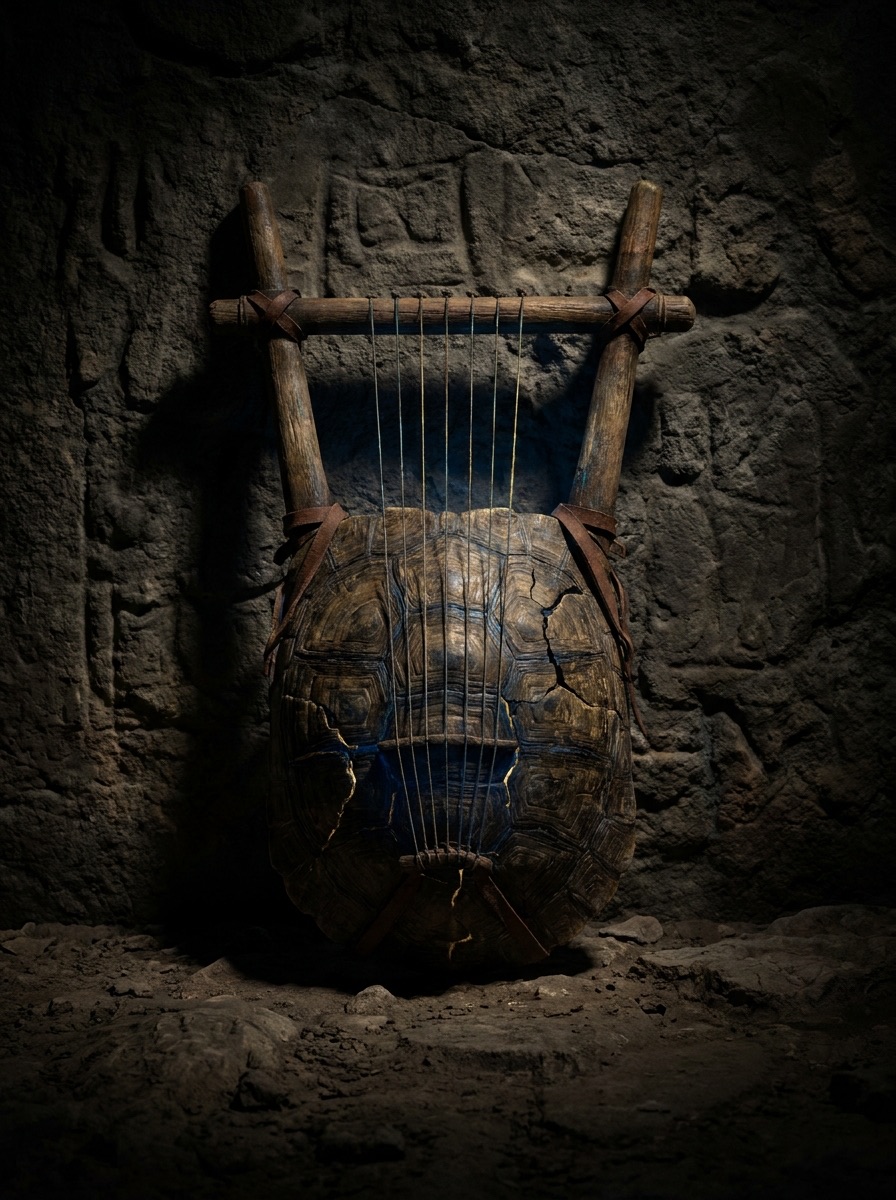
Hermes' Lyre is a musical instrument in Greek mythology said to have been made by Hermes, often from a tortoiseshell. It is also known as Hermes' lyre and the tortoiseshell lyre. In *Hermes Steals Apollo's Cattle*, Hermes makes the first lyre on his first day of life, showing his quick wit, inventiveness, and restless nature.
Origin Story
Hermes' Lyre originated on Hermes' first day of life. Maia gave birth to Hermes, son of Zeus, in a cave in Arcadia. The infant soon left his cradle, found a tortoise at the cave mouth, and used its shell to make the first lyre. That origin makes the instrument a mark of Hermes' precocious wit and ingenuity.
Powers
Hermes' Lyre shows no combat, protective, or prophetic power in the surviving narrative. Its function is as a musical instrument, and as a symbol of Hermes' ability to turn ordinary material into a new artifact. The tortoiseshell lyre presents Hermes from the beginning as an inventor and a god of cleverness.
Article
Artifact role
Hermes' Lyre is a lyre linked to Hermes' early life. Its importance lies in invention and craftsmanship rather than combat. The story places it on Hermes' first day of life, underscoring his speed, ingenuity, and skill from birth.
Bearer and use
In the surviving narrative, Hermes is the maker of the lyre. After being born in a cave in Arcadia, he quickly left his cradle, found a tortoise at the cave mouth, and turned its shell into the first lyre. The story does not say who later kept it, or whether it was passed on, exchanged, or lost.
Traditions and reliability
Hermes Steals Apollo's Cattle explicitly preserves the episode in which Hermes makes the first lyre from a tortoise shell. This is the most reliable basis for the artifact.
In broader classical tradition, Hermes is often associated with wit, theft, invention, travel, and messages, and the lyre is commonly treated as a sign of that inventive power. The surviving material here does not develop the later relation between the lyre and Apollo, so that tradition is not treated as a confirmed plot point.