Greek Mythology
Aegis — Greek Mythology
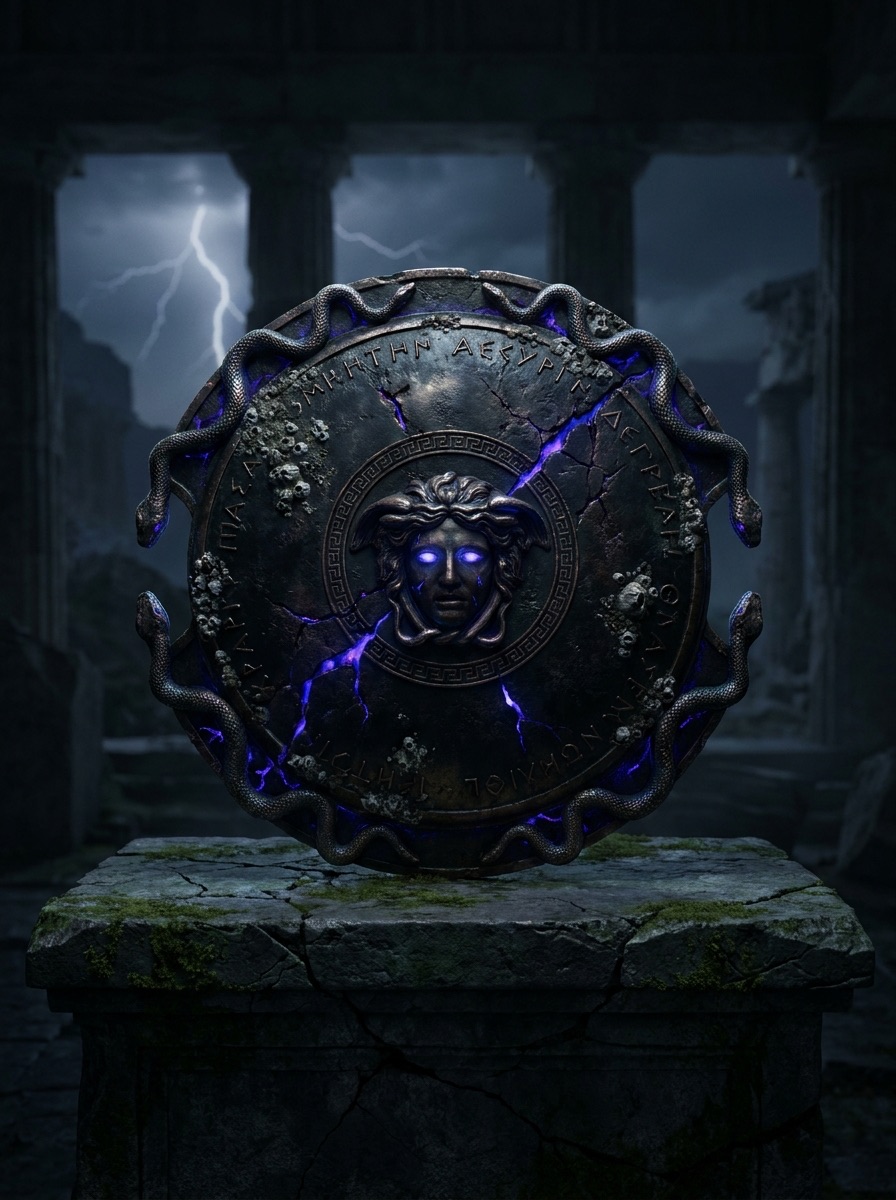
The Aegis is a sacred protective implement and emblem of sovereignty in Greek mythology. It belongs chiefly to Zeus, but is also often held or worn by Athena. It is commonly described as a shield, breastplate, or tasseled goatskin, with aliases such as Divine Shield, Aegis of Zeus, and Aegis of Athena, and is sometimes associated with the head of the Gorgon.
Origin Story
No core story clearly states a single origin for the Aegis. A common tradition holds that it originally belonged to Zeus and was later also held or used by Athena. Other traditions connect its name with goatskin and see it as carrying ancient meanings of protection and terror. Because different classical authors and later interpretations vary in its form, material, and ownership, the Aegis is best understood as a sacred protective implement shared by Zeus’s divine authority and Athena’s armed image.
Powers
The Aegis’s main powers are protection, intimidation, and suppression. When Zeus holds it, it symbolizes the majesty and punitive force of the divine king; when Athena wears or bears it, it strengthens the goddess’s battlefield terror, making enemies afraid, confused, or driven back. The Aegis associated with the Gorgon’s head also has an apotropaic function and inspires dread in enemies, combining sacred defense with martial authority.
Article
Basic form
The Aegis is an important symbol of Olympian divine authority. It is both protective gear and a manifestation of divine power. In classical tradition, it sometimes appears as a shield, sometimes as a breastplate or leather guard worn over the shoulders. Its edge may be fringed with tassels, and it can terrify enemies on the battlefield.
Bearers and use
The Aegis is most often associated with Zeus, representing the rule, protection, and punitive power of the lord of thunder. Athena also often bears the Aegis, especially in images of war and civic protection. Athena’s Aegis is commonly paired with serpent ornaments, the Gorgon’s head, and the fully armed appearance of the goddess. In “The Birth of Athena,” Athena emerges from Zeus’s split skull fully armed and holding a spear; this image accords with later traditions in which she bears shield and armor and protects the city.
Traditions and reliability
The core narrative material clearly preserves only the image of Athena being born “fully armed,” and does not directly state the Aegis’s name, material, or origin. Broader classical tradition and encyclopedia sources, however, identify the Aegis as a signature protective implement of Zeus and Athena, and explain that it may be called a divine shield or a goatskin guard.
Traditions about its form are not entirely consistent. Some accounts emphasize it as the shield of Zeus; others treat it as armor worn on Athena’s chest or shoulders; still others explain it as a goatskin imbued with sacred power. The combination of the Gorgon’s head and the Aegis is one of the most common forms in images of Athena.