Greek Mythology
Achilles's Armor — Greek Mythology
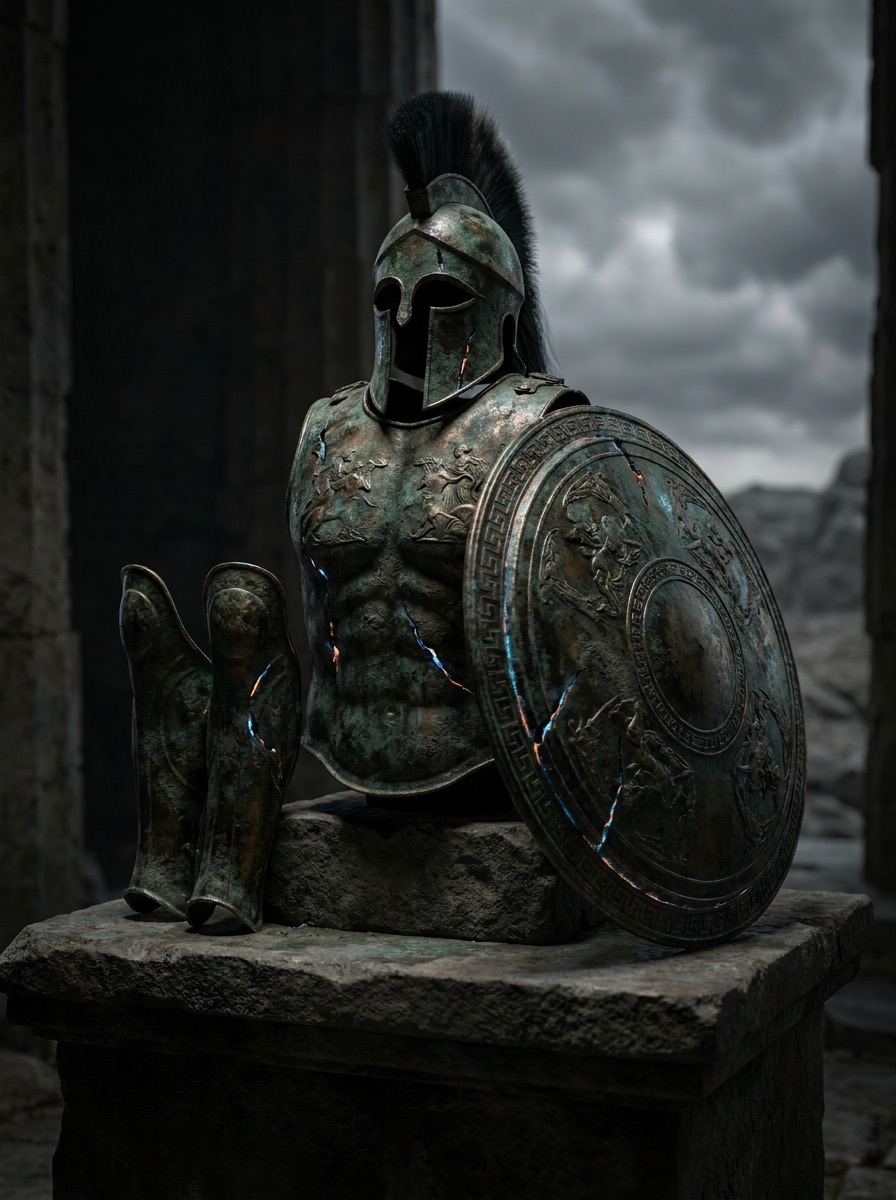
Achilles's Armor is the divinely forged armor of the Trojan War tradition. Hephaestus, the god of the forge, remade it for Achilles. It includes a breastplate, helmet, greaves, and the famous great shield. It is also known as Achilles's New Armor or the God-forged Armor, and the shield is especially famous for its images of cities, fields, stars, and human life.
Origin Story
Achilles's New Armor begins with the death of Patroclus. Patroclus went into battle wearing Achilles's old armor, briefly pressed the Trojans back, and was then killed by Hector. The old armor fell into Hector's hands, and Achilles lost the gear he needed to return to battle.
Thetis rose from the sea, heard her son's grief, and knew that if he went to war again, death would come even closer. She went to Hephaestus's workshop and asked the god of fire to forge new weapons and armor for Achilles. Working by the furnace, Hephaestus made a strong breastplate, helmet, greaves, and great shield. The next day, Thetis brought the new armor to Achilles, and he was armed again, ready to take revenge on Hector.
Powers
Achilles's Armor provides the strong protection of divine craftsmanship, shields the hero's body, and shines with dazzling radiance on the battlefield, intimidating enemies and onlookers alike. The images on the shield carry strong symbolic force, presenting a world beyond war: civic order, labor, marriage, dispute, ritual dance, and the starry sky. It is often regarded as one of the grandest objects described in Homeric epic. Its power lies chiefly in divine workmanship, battlefield intimidation, and narrative symbolism rather than in a spell that makes the bearer immortal.
Article
Basic Definition
Achilles's Armor is one of the most important pieces of heroic equipment in the Homeric tradition. It is not a single piece of protection, but a complete set of war armor. Common descriptions include a breastplate, helmet, greaves, and shield, and the shield receives the most detailed treatment.
This armor marks Achilles's return to battle. Patroclus had earlier gone out wearing Achilles's old armor, was killed by Hector, and lost the armor as well. Achilles was then left without usable gear and had to rely on his mother Thetis to ask Hephaestus for a new set.
Bearer and Use
The bearer of this armor is Achilles. The maker is Hephaestus. Thetis, as Achilles's mother, brought the new armor back from the divine craftsman to the Greek camp.
In The Re-arming of Achilles, Achilles puts on the new armor, and the Greeks see its bright radiance. He then drives his chariot into battle and moves toward his duel with Hector. In the narrative, the armor not only protects him, but also shows Achilles re-entering war through grief.
Variants and Reliability
The Re-arming of Achilles and Achilles and Hector both preserve the core plot of this new armor: Hector takes the old armor, Thetis asks Hephaestus to forge a replacement, and Achilles arms himself again and returns to battle.
The Iliad, Book 18, is the most important classical source for this armor. That book gives a detailed account of Hephaestus forging the shield and lists the images on it, including cities, weddings, lawsuits, plowing, harvesting, vineyards, cattle, a dance floor, and the stars. In the broader classical tradition, the Shield of Achilles is often discussed on its own, but it is usually still treated as part of this divinely forged armor.
No reliable source says that this new armor made Achilles immune to death. It strengthened his protection and battlefield presence, but it did not change the fate that drew close to him.